By Dr. Chris Cormier, DC — EBOO Prime
We are a clinic, and we are about to hand you the list of questions we would want you to ask a clinic. That is deliberate. Choosing a clinic well is good for you and good for us, because the places that answer these questions easily are the places we are happy to be compared with.
Here is the principle that runs through all of it: when you ask a good question, the useful information is in how readily it is answered, not only in the answer itself. A clinic that welcomes the question has told you most of what you needed to know before it says a word.
None of what follows requires any medical knowledge. Knowing how to choose a clinic is a handful of plain questions asked in a sensible order, and most of it can be done from your phone before you ever walk in.
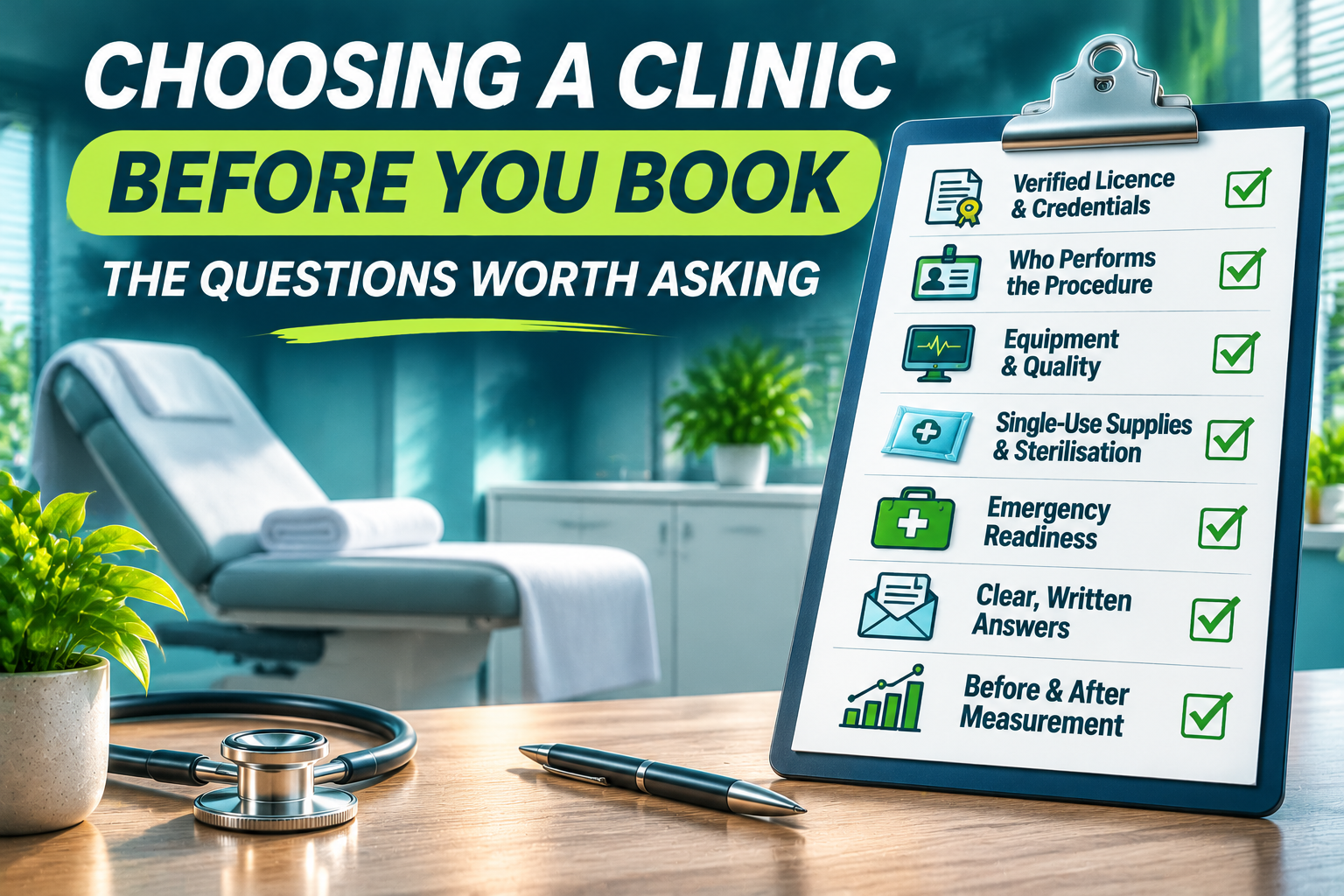
Start with the licence, because it is the only binary check
Almost everything else on this page is a judgement call. This one is not: a licence is either current or it is not.
Every state has a regulatory board that licenses clinicians and, in many cases, facilities. Those boards publish online lookup tools that are free and take a couple of minutes. You can confirm that a licence is active, and you can usually see whether there is any disciplinary history attached to it.
One specific thing to listen for when choosing a clinic: the difference between licensed and trained. Those words do very different work. A state licence is issued by a public body and can be looked up by you. A certification may represent years of formal study, or a vendor course that ran over a weekend — and from the outside the two look identical on a website. So the question is not “are your staff trained?” It is “which licence does the person treating me hold, and in which state?” That version has an answer you can go and verify.
A clinic that is proud of its credentials will give you the numbers without being asked twice. Some publish them on the site, which is the gold standard and saves everybody a phone call.
Ask who will actually be in the room
This catches more people than any other item here, and it is not a trick question — it is simply an easy detail to assume.
The person who gives you the consultation is not always the person who performs the procedure. At larger practices that is often perfectly normal and perfectly safe. But you want to know it in advance rather than discover it on the day.
- Who will carry out the procedure itself?
- What is their licence, and how long have they been doing this particular thing?
- How often do they do it — weekly, monthly, a few times a year?
Frequency is the one people forget to ask about, and it is genuinely informative. Somebody who performs a procedure several times a week has encountered the awkward variations. Somebody who does it occasionally may be excellent and may simply have seen less.
The consultation is itself the test
A good consultation has a particular shape, and once you have seen it you can recognise it anywhere.
It starts with your history rather than with the treatment. You should be asked what you are hoping to change, what else is going on with your health, what medication you take. If a clinic recommends something before it has asked those things, it has recommended it to a category of person rather than to you.
You should also never be asked to sign a consent form before you have had that conversation. Consent follows the discussion; it does not replace it.
The strongest signal of all is a clinic that is willing to tell you no. If nobody is ever turned away, the assessment is not doing any work.
We say no reasonably often, and it is not a difficult conversation to have. Somebody for whom this is not appropriate is better served hearing that at the enquiry stage than four sessions in.
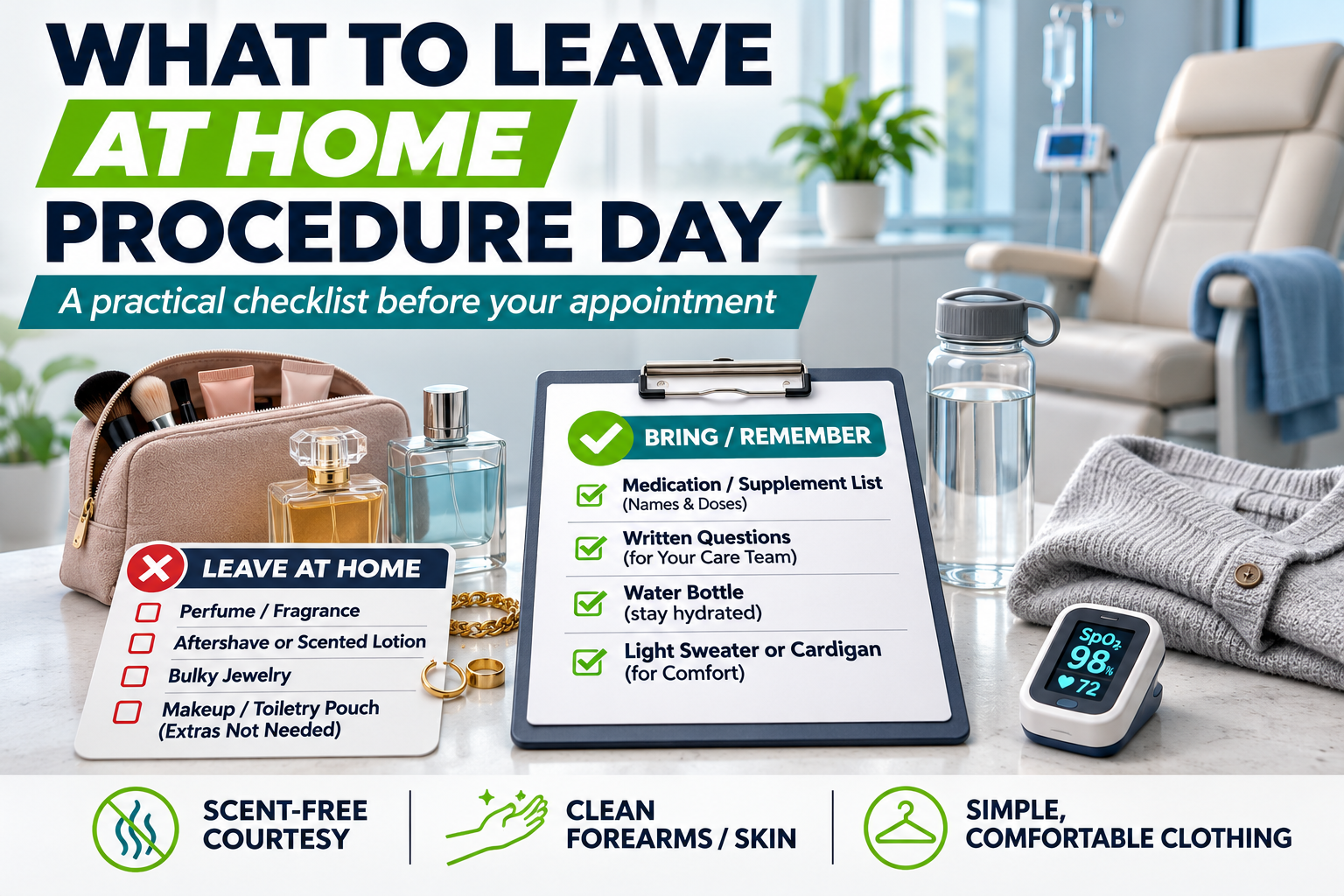
Bring your full list to that conversation, and make it genuinely full — prescriptions, supplements, powders, drinks, anything you take regularly. People routinely leave the supplements off because they do not feel like medication, and they are exactly the thing a clinician needs to see. The Nerve Health Institute wrote about why that matters more than most people expect in vitamin B6 toxicity and nerve symptoms, and the same principle applies in any consultation: the clinician can only work with what you put on the table.
Our companion pages on this are questions to ask before a procedure, which covers the treatment itself, and what to tell your doctor before a procedure, which covers the conversation in the other direction.
Equipment, consumables and cleanliness
This is a fair question and a good clinic answers it without any defensiveness at all, so do ask it.
- What make and model is the equipment, and where did it come from? You are entitled to know, and the answer should be specific rather than a category.
- Which parts are single-use? Anything disposable should be opened in front of you, not brought in already prepared.
- For anything reusable, what is the sterilisation process, and is it validated?
The visual check costs nothing while you are there. Rooms should be uncluttered and organised, surfaces disinfected between patients, sharps containers present and properly used, gloves changed between steps. None of that requires expertise to notice.
Watching single-use items come out of sealed packaging in front of you is the simplest reassurance available in any clinical setting, and it is entirely normal to expect it. Nobody competent is offended by a patient paying attention.
Ask what happens if something goes wrong
This is the most useful question on the page and the one almost nobody asks, because it feels impolite. It is not impolite. It is the question a clinic should most want to answer, and the reaction to it tells you a great deal when you are choosing a clinic.
- What emergency equipment is on site, and who is trained to use it?
- Who makes the decision if I have a reaction during the procedure?
- What is your policy if I need care at another facility afterwards?
- Who do I contact afterwards with a question, through what channel, and how quickly do you reply?
- What paperwork will I leave with?
Ask for those answers in writing. Not because anybody is expecting trouble, but because a clinic that has thought this through already has the answers written down somewhere, and one that has not will discover that while you wait.
The written-answer test
Here is a quiet, effective check that takes one email.
Once you are seriously choosing a clinic, send your questions in writing and see what comes back. A clinic that answers in writing has put its answers on the record, which is exactly what a confident operation is content to do. A clinic that will only ever discuss things by phone or through a messaging app — where a conversation leaves no trace — has made a choice, and it is worth noticing.
Two other patterns are worth knowing about while choosing a clinic, simply so they do not catch you off guard:
- Pressure to decide today. A good clinic actively wants you to take your time, because a patient who has thought it through is a better patient.
- Being sold a large package before you have had a single session. Try one. Then decide.
Our colleagues at Body Charger set out the same principle for products rather than providers in biohacking at home — the four questions there transfer neatly to clinics.
Measurement before and after
One last item, and it is the one that protects your money rather than your safety — which is why it is the step most often skipped when people are choosing a clinic in a hurry.
Ask what will be measured before you start, and what will be measured afterwards to see whether anything changed. A clinic that records a baseline is a clinic prepared to be held to an outcome. One that offers nothing measurable is asking you to judge the result on how you feel about having spent the money, which is not a reliable instrument.
We wrote our own position on this in how do you know if a treatment is working. And if you arrive at appointments carrying a bag of bottles and a list of things you have already tried, Dr. Cormier wrote about exactly that in the patients who arrive with a list.
Now apply all of it to us
It would be a strange page that handed you a checklist and then exempted the clinic that wrote it. So here is where we stand.
Ask us for the licence of whoever will treat you, and we will give you the number. Ask who will be in the room, and you will be told before the day, not on it. Ask what the equipment is and where it came from, and you will get a specific answer. Ask what happens if you react, and what we do if you need care elsewhere, and we will put it in writing. Ask what we will measure, and we will tell you before you book rather than after.
And if the honest answer to your enquiry is that this is not the right thing for you, you will hear that too. We do not treat, prevent, cure or mitigate any disease, and we would rather lose a booking than win one on a misunderstanding.
We are aware that publishing a checklist invites you to use it on us, and that is the point. A clinic that would rather you did not ask these questions has told you something. We would rather be the clinic that handed you the list.
If you want the background before you ask anything, what is EBOO covers the procedure in plain language, how it works covers the mechanics, what to expect at an EBOO session walks through the appointment itself, and can you have too much oxygen answers the safety question people tend to be too polite to ask.
Frequently asked questions
How do I check if a clinic is legitimate?
Knowing how to choose a clinic starts with the state licensing board, which publishes free online lookup tools showing whether a clinician’s licence is active and whether there is disciplinary history. Then ask who will perform the procedure, what equipment is used, and what happens if something goes wrong. Ask in writing.
What questions should I ask a clinic before booking?
Which licence does the person treating me hold and in which state; who will actually perform the procedure and how often do they do it; what make of equipment is used and which parts are single-use; what emergency provision is on site; what happens if I need care elsewhere; and what will be measured before and after.
Is it rude to ask a clinic about complications?
Not at all, and a clinic that treats it as rude has answered the question. Somewhere in any properly run practice there is a written protocol for exactly this. Asking to see it is ordinary diligence.
What is the difference between a licensed and a certified practitioner?
A licence is issued by a state regulatory body, carries legal scope of practice, and can be independently verified by you. A certification is issued by a private organisation or a manufacturer and can represent anything from extensive formal training to a short course. Ask specifically which licence is held.
Should I book a package of sessions upfront?
Try a single session first wherever that is possible. Discounted packages are not inherently a problem, but committing to a course of treatment before you have experienced one removes your ability to change your mind cheaply.
Ask us anything on this list
Send the questions. All of them, in writing if you prefer — that is the version we like best, because it means our answers are on the record.
Enquire with EBOO Prime — or read our FAQ first, which answers most of this before you have to ask.
Spark your cells to optimal longevity.
— Dr. Chris Cormier, DC
EBOO Prime