By Dr. Chris Cormier, DC — EBOO Prime
We wrote recently that cold hands are usually not a circulation problem — which is true, and the most common question we get asked.
This page is the other half of that. There is one leg symptom that genuinely is a circulation problem, it has a very specific pattern, and it is the one most often waved away as getting older.
Knowing the pattern takes two minutes to learn, and it is worth knowing.
The pattern that matters
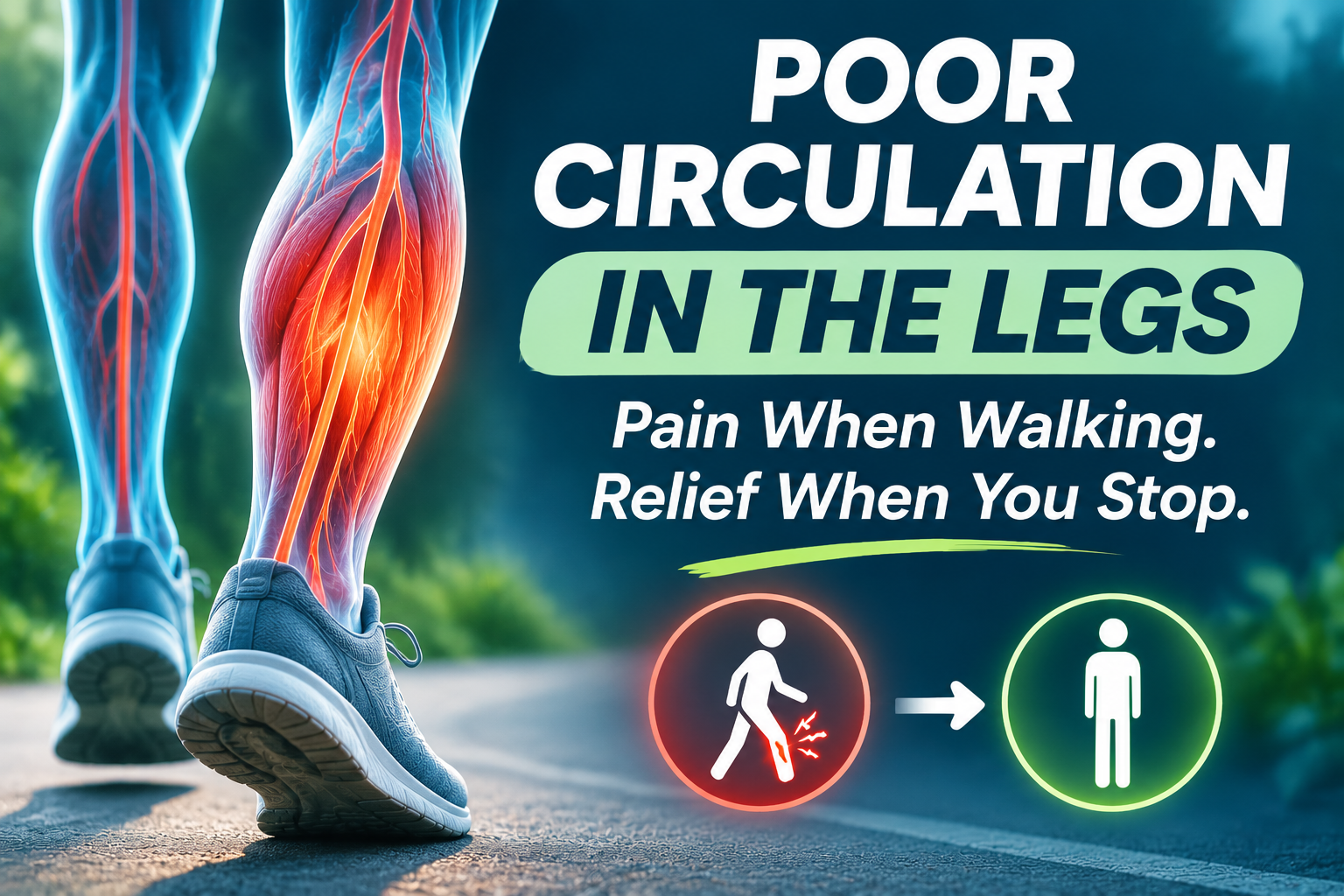
The classic symptom of poor circulation in the legs is pain that comes on when you walk and goes away when you stop.
It is usually described as cramping, aching, burning, heaviness or tightness — most often in the calf, sometimes in the thigh, hip or buttock. It tends to arrive sooner going uphill or climbing stairs, because the muscles are asking for more blood than the arteries can deliver.
The medical term is intermittent claudication, from the Latin for limping. The underlying condition is peripheral artery disease — narrowing of the arteries supplying the legs.
It is the muscles saying, politely at first, that they are not receiving enough blood to do what is being asked of them.
Three tells that separate it from everything else
Leg pain is common and most of it is not this. These three features are what point towards circulation rather than something else.
1. The same distance, every time
This is the most useful single clue. Circulation-related leg pain tends to come on at a reproducible distance — the same two hundred yards, the same hill, the same point on the walk to the shops. Pain from a back or joint problem is usually far more variable from day to day.
2. Standing still is enough
With a circulation cause, simply stopping and standing for a few minutes relieves it. You do not need to sit down, lean forward or change position.
That detail genuinely matters, because the main look-alike behaves in the opposite way. With spinal narrowing, standing often brings the pain on, and relief usually requires sitting or bending forward — which is why some people find they can push a shopping trolley much further than they can walk unaided.
3. It is in the muscle, not the joint
Circulation pain sits in the meat of the calf or thigh. Joint pain sits in the knee, hip or ankle. Nerve pain tends to be sharp, burning or shooting, often travels down the leg, and does not reliably settle with rest.
None of this is a substitute for an examination. It is a way of deciding that the conversation is worth having, which is the whole purpose of this page.
The version that hides itself
This is the part we find most interesting, and the reason this condition goes unrecognised so often.
People adapt around it without noticing. They walk a little less, take the car for short journeys, sit down more, choose the flat route — and because the adaptation is gradual and sensible-feeling, the pain stops happening and the problem stops being visible. Vascular specialists describe patients subconsciously becoming more sedentary as a way of compensating.
From the outside it looks like slowing down with age. From the inside it feels like a series of reasonable choices. Neither description mentions the arteries.
So a better question than “does my leg hurt?” is: am I walking less than I was two years ago, and do I know why?
Dr. Cormier has written about the same pattern from a different angle in my mother had it too — how a decision about what is coming quietly produces the behaviour that makes it likelier.
And the version with no pain at all
A substantial proportion of people with poor circulation in the legs have no leg pain whatsoever — by some estimates up to four in ten. Other signs worth knowing:
- Legs that feel tired or heavy rather than painful
- Cuts, sores or blisters on the feet or toes that are slow to heal
- Skin that has changed colour, or looks shiny
- Hair loss on the lower legs, or toenails growing more slowly
- One foot noticeably colder than the other
- A slower walking pace, or a limp that has crept in
That last point about one side is the one we would underline. As we wrote in why are my hands and feet always cold, temperature regulation is even-handed — it cools both feet together. A difference between the two sides is a different question entirely.
Who is more likely to have it
Roughly one in twenty people over 50 has peripheral artery disease, and the likelihood rises with age. The risk is higher if you:
- are over 50, and particularly over 65
- have diabetes
- have high blood pressure or raised cholesterol
- smoke, or used to
- have a family history of vascular disease
- have already had a heart attack or stroke
If you have diabetes, there is an additional reason to take leg and foot symptoms seriously: nerve changes can mask the pain that would otherwise be the warning. In that situation, slow-healing wounds matter more than pain does.
Why it matters beyond the legs
Here is the piece most people are never told.
Narrowing in the arteries of the legs usually means the same process is happening elsewhere, so it is a marker of raised risk for heart attack and stroke. Finding it is not only about the legs — it is a prompt to look after the whole cardiovascular system, and that is genuinely useful information to have early.
Which is why a symptom that seems minor is worth a conversation. The legs are often the first place the body mentions it.
When to act quickly
Go to an emergency department now if a leg or foot becomes suddenly painful, pale, cold, numb or weak. A sudden loss of circulation to a limb is a medical emergency and treatment is time-critical.
And make an urgent appointment — within days, not months — if you have:
- Pain in the foot or toes at rest, particularly at night when your foot is flat in bed, and relieved by hanging the leg over the side
- A wound, ulcer or sore on the foot or leg that is not healing
- Any area of blackened or breaking-down skin on the foot or toes
Those are signs that circulation has become more seriously limited, and they are treated urgently. Everything earlier on this page is an ordinary appointment rather than an alarming one — but it is an appointment worth making.
What happens when you get it checked
Reassuringly little, which is worth knowing in advance.
Your doctor will ask about the pattern — how far you walk before it starts, what relieves it — and feel the pulses in your feet. The first-line test is the ankle-brachial index: blood pressure measured at your ankle and compared with your arm. It takes a few minutes, it is painless, and it involves nothing more than a blood pressure cuff and a small ultrasound probe.
If that suggests narrowing, an ultrasound scan usually follows. This is one of the easier things in medicine to investigate, and the answer is often the same appointment or the next one.
The genuinely good news
Most people with poor circulation in the legs do well with medication, exercise and lifestyle changes. It is managed far more often than it is operated on.
And the central treatment is a surprising one: supervised walking. Walking to the point of discomfort, resting, then walking again improves symptoms and increases walking distance over time, partly by encouraging smaller vessels to develop as alternative routes around the narrowing.
Which produces an unusual situation. The instinct — to walk less because it hurts — is precisely the opposite of the treatment. Done under medical guidance, the thing that triggers the symptom is also the thing that improves it. That is worth knowing before you adapt your way around it for another two years.
Keeping strength and mobility alongside that matters too — BodyCharger has a practical guide to building strength at home after 50, and the clinic has written on why strength fades faster than muscle size in muscle loss after 50.
Where we fit, and where we do not
We should be as clear about this as we were on the cold hands page.
EBOO is a circulation and oxygenation therapy, and the circulatory system is what we spend our working lives thinking about. It is not a treatment for peripheral artery disease, and we would not present it as one. If the pattern on this page sounds like you, the people you need are your doctor and, if required, a vascular specialist. That is not us, and saying so plainly is more useful to you than anything else we could write here.
What we can offer is the explanation — what the circulatory system is doing, why the small vessels matter so much, and what the research does and does not support. What EBOO is and how it works set out our side honestly, why oxygen matters to the body covers the wider picture, and circulation and pelvic floor health looks at another area people rarely connect to blood flow.
If you are weighing up any treatment — ours included — our guide to how to tell whether a treatment is working is the one we would most want you to read first.
Frequently asked questions
What does poor circulation in the legs feel like?
Most characteristically, cramping, aching or heaviness in the calf, thigh or buttock that comes on while walking and settles within a few minutes of stopping. It often arrives at a similar distance each time and sooner on hills or stairs.
How do I know if it is circulation or my back?
Circulation pain usually comes on at a reproducible distance and is relieved by simply standing still. Pain from spinal narrowing is more variable, is often brought on by standing, and usually needs sitting or bending forward to ease. Only an examination settles it, but the pattern is a strong clue.
Can you have poor circulation in the legs without pain?
Yes — by some estimates up to four in ten people with it have no leg pain. Slow-healing foot wounds, heavy or tired legs, skin or nail changes, hair loss on the lower legs and one foot being colder than the other are all worth mentioning.
Is leg pain when walking just part of getting older?
No. It is common with age, but common is not the same as normal, and there should be a better explanation than age alone. It is one of the more underdiagnosed conditions in this age group precisely because it gets dismissed.
What test is used to diagnose it?
The ankle-brachial index — blood pressure at the ankle compared with the arm. It takes a few minutes, is painless, and is usually followed by an ultrasound scan if it suggests narrowing.
Should I rest the leg or keep walking?
Ask your doctor, because supervised walking is a core treatment rather than something to avoid. Walking to discomfort, resting and walking again improves walking distance over time — but that should be done with medical guidance, not guessed at.
The two-minute version
Pain on walking that stops when you stand still. Same distance each time. In the muscle, not the joint. That pattern deserves an appointment, not an explanation about getting older.
And if you are not sure whether you are walking less than you used to, ask somebody who sees you often. They will usually have noticed before you did.
If the person you are reading this for is somebody else, BodyCharger has a practical piece on getting them to go. To talk to us about circulation and oxygenation, read our FAQ or get in touch.
Dr. Chris Cormier, DC
EBOO Prime
Circulation and oxygenation at ebooprime.com. Clinic care at nervehealth.com. At-home protocols at bodycharger.com. Essays at drchriscormier.com.
Spark your cells to optimal longevity.