By Dr. Chris Cormier, DC — EBOO Prime
Inflammation has become the most blamed word in health. It gets named as the cause of almost everything, which has had an odd effect: a word that explains everything explains nothing.
So let us be precise, because the precise version is far more useful. Inflammation is not the problem — it is one of the most sophisticated repair systems your body owns, and you would not survive a week without it. The thing worth your attention is narrower: chronic inflammation — inflammation that started correctly and then never finished.
That distinction changes the question you ask. Most people ask how to reduce inflammation. The better question is why a particular inflammation has not resolved. Those are different questions, and the second one is the one that helps.
Inflammation is how your body heals
Cut your finger. Within minutes you get redness, heat, swelling and tenderness. Those four signs have been described in medicine for two thousand years, and every one of them is a deliberate engineering decision.
Redness and heat: blood vessels widen so more blood arrives. Swelling: the vessel walls turn deliberately leaky, so plasma, clotting factors and white blood cells can leave the bloodstream and reach the tissue. Tenderness: nerve endings sharpen, which is how your body tells you to rest that part.
None of that is damage. That is a delivery system opening up: white cells arrive, clear the bacteria and the broken tissue, and the repair crew follows.
People who cannot mount a proper inflammatory response are in real difficulty. So the goal was never zero inflammation. A body with no inflammatory capacity is a body that cannot heal.
The difference is not the inflammation — it is the resolution
Here is the part most health content leaves out, and it is the part that makes everything else make sense.
For most of the twentieth century it was assumed inflammation ended passively — that the signals which started it simply ran out, like a fire burning through its fuel. That turned out to be wrong. Resolution is now understood as a highly active process in its own right.
The body builds and releases a separate class of molecules whose entire job is to bring inflammation to a close and restore the tissue. They are called specialized pro-resolving mediators, and they are built largely from omega-3 fatty acids. Immune cells switch mode, the cells that did the fighting are cleared away, and the vessel walls seal back up.
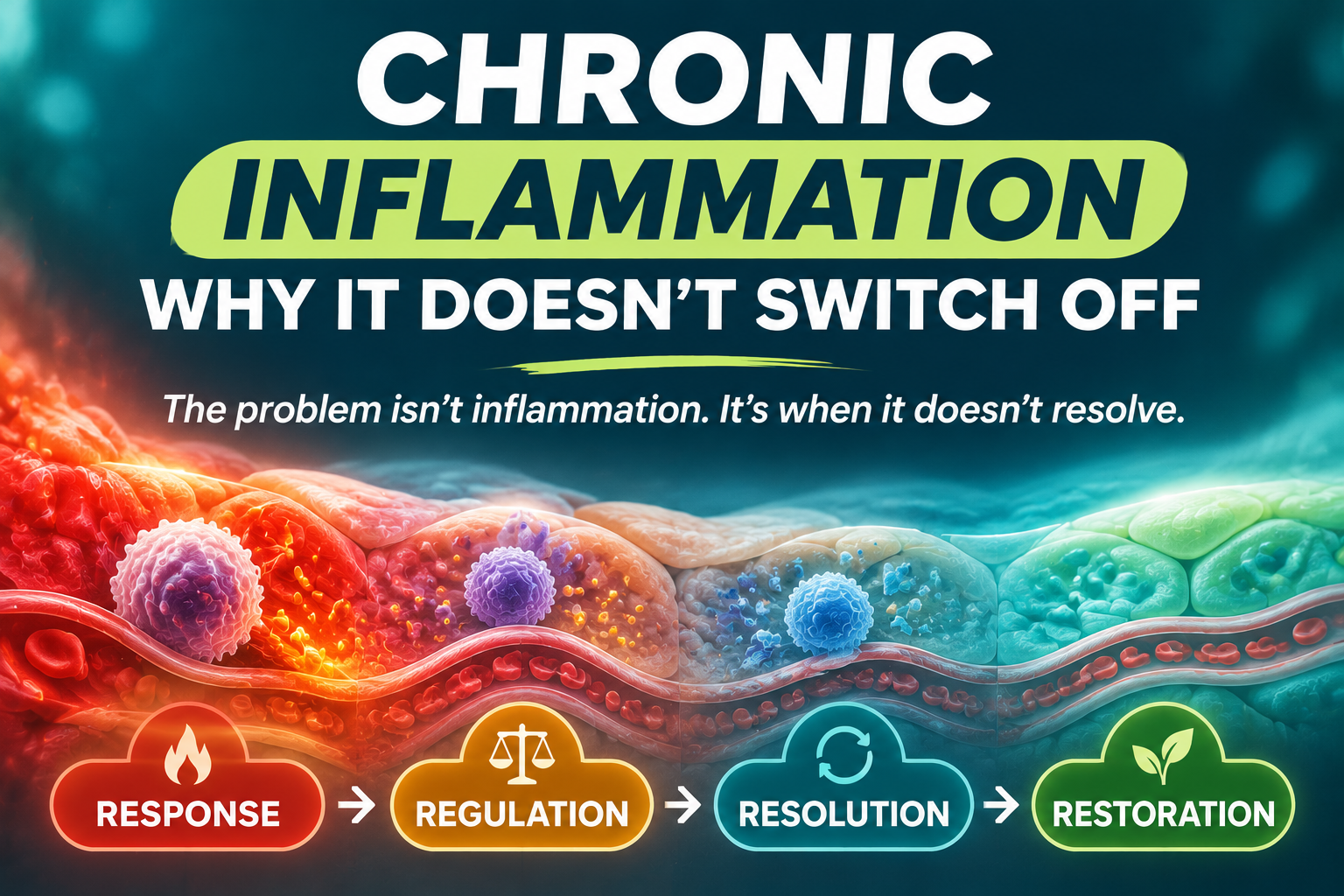
Described in full, the process has four phases: response, regulation, resolution, and restoration — that last one meaning the return of the tissue to its normal, healthy state.
Chronic inflammation is what happens when the sequence gets stuck in phase three. The response fired correctly. The off-switch — which is not a switch at all, but an active, built, delivered signal — did not complete.
That reframes the whole subject, and it reframes it in your favour. This is rarely a body doing too much. It is usually a body not finishing something — and “not finishing” has causes you can look for.
Why chronic inflammation becomes more common with age
There is a name for the low-grade, persistent version that accumulates across decades: inflammaging. It describes a low-level inflammatory state that persists in the absence of any infection and tracks with declining function across many tissues.
What is striking is exactly where the age-related change sits. In animal research, older animals produce the pro-inflammatory signals at the same levels as young animals. What they do less well is produce the pro-resolving ones. The literature points consistently the same way: ageing is associated with impaired resolution and with less efficient clearance of spent immune cells.
Read that carefully, because it is good news dressed up as a technicality. The ageing change behind inflammaging is not that your body becomes more inflamed. It is that your body becomes slower at closing things out. And closing things out is logistics — delivery, clearance, circulation, raw materials, sleep. Logistics can be supported.
This is one of the clearest places where the length of your life and the quality of it come apart, which our colleagues at The Nerve Health Institute cover in healthspan vs lifespan.
What chronic inflammation feels like
Mostly, it does not.
This is the single most practical point on the page. Acute inflammation announces itself — red, hot, swollen, sore, in a specific place. The low-grade chronic kind is quiet. There is no reliable sensation that tells you your inflammatory markers are raised.
Which means it is measured, not felt. The common markers are C-reactive protein — usually the high-sensitivity version, hs-CRP — and interleukin-6, or IL-6. Both come from an ordinary blood sample.
So when someone tells you they can feel their inflammation levels, be gently curious. What people genuinely feel is fatigue, morning stiffness, slower recovery, poorer sleep. All of it is real and worth addressing. None of it is a measurement.
If you want to know where you stand, the route is a blood test ordered by a clinician who reads it against everything else about you. We hold our own work to the same standard, which is why we wrote how do you know if a treatment is working.
What “anti-inflammatory” actually means
The word has become a marketing category, so it is worth separating what is established from what is hopeful. We would rather do that than sell you a certainty we do not have.
What is well established is that dietary patterns relate to measured inflammatory markers. A 2025 study from King’s College London, published in the Journal of Periodontology, examined 195 patients who each had a full periodontal assessment, a blood sample and a food questionnaire. Low adherence to a Mediterranean-style diet was associated with the most advanced stages of gum disease, alongside higher circulating CRP and IL-6, and plant-derived food groups showed an inverse relationship with those markers.
Notice the shape of that finding: a dietary pattern, across whole categories of food, associated with a measured marker. That is the level at which the evidence on chronic inflammation and diet is solid, and it is a useful level — it tells you to change how you eat, not what single item to buy.
What is much weaker is any claim that one food, spice or supplement reliably lowers your inflammatory markers in a way that changes your health. There is real science behind the omega-3 story, since those fatty acids are the raw material for pro-resolving mediators. But “this molecule participates in resolution” and “taking this will resolve your inflammation” are very different claims, and the gap between them is where most supplement advertising lives.
Our colleagues at Body Charger wrote a practical guide to reading claims like these: how to know what health advice to trust.
The source of chronic inflammation that gets missed
Dental health belongs in any honest discussion of this subject, and it almost never gets a mention.
Gum disease is a bacterially driven, immune-mediated inflammation of the tissue around your teeth, and what it generates does not stay in your mouth. C-reactive protein runs consistently higher in people with periodontal disease than in people with healthy gums, and CRP has been proposed as one of the markers linking gum disease to disease elsewhere in the body.
Which makes a dental appointment one of the highest-value and least glamorous items on any chronic inflammation list. It costs an afternoon, it addresses a real and measurable source of inflammatory signalling, and virtually nobody frames it that way.
Where circulation comes into it
Now our own subject — and we will keep the physiology ahead of the sales pitch.
Resolution is a delivery and clearance operation. Pro-resolving signals have to reach the tissue. Immune cells have to arrive, work, and then be removed. Oxygen has to be present for the repair itself, because building new tissue is energetically expensive. All of that traffic moves through the smallest blood vessels — the capillaries, of which you have somewhere in the order of ten billion.
A tissue that is well perfused has everything resolution requires arriving steadily. A poorly perfused one does not. The inflammatory signal can be entirely normal and resolution can still stall, simply because the logistics are not there.
That is not a mechanism we invented. It is the ordinary reason wounds heal slowly in poorly circulated tissue, and why circulation is assessed as routine whenever healing is delayed.
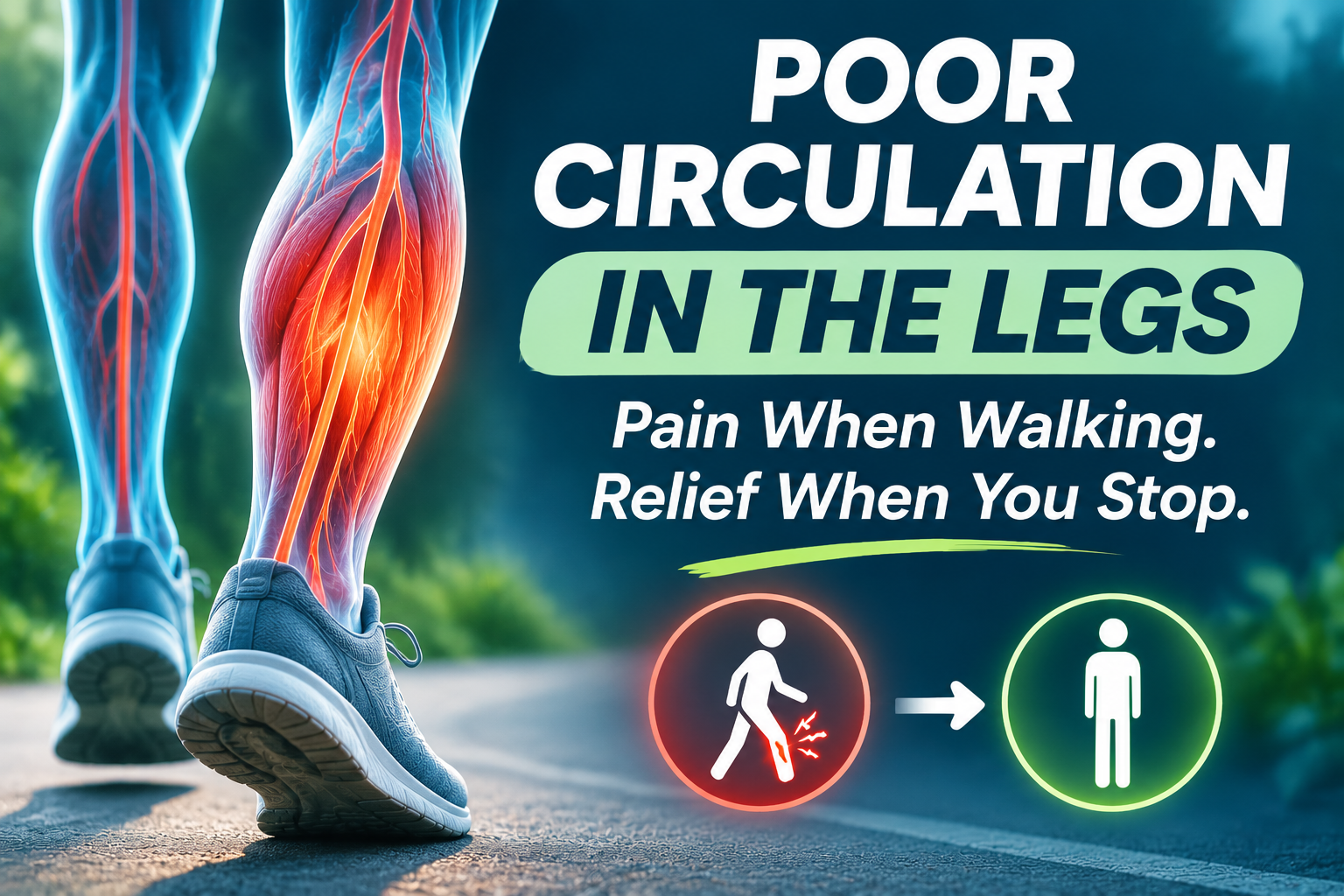
It is also why we spend as much time on circulation as on oxygen. For the underlying physiology, why is oxygen important for the body covers the delivery side, and poor circulation in legs covers what genuinely reduced circulation looks and feels like, including the one symptom pattern that is worth taking straight to a doctor.
The reverse caution matters just as much. Cold hands and feet, which almost everyone assumes is a circulation problem, usually is not one. We wrote why are my hands and feet cold precisely because we would rather be right than agreeable.
What genuinely helps with chronic inflammation
Grouped by how much confidence the evidence allows, which is more respectful than a flat list implying everything is equally proven.
Strong confidence
- Sleep. Short and disrupted sleep is one of the most consistently reported influences on inflammatory markers, and it is free. Body Charger has a guide to how to sleep better naturally.
- Not smoking. The clearest single modifiable input on this entire page.
- Regular movement. Habitual physical activity is associated with lower inflammatory markers, and it does not require athleticism.
- Dental health, for the reasons above.
- Treating the underlying condition. Where a diagnosed condition is driving things, the treatment for it is the anti-inflammatory intervention. Nothing on this list substitutes for it.
Good confidence
- Dietary pattern. A Mediterranean-style pattern — fruit, vegetables, legumes, whole grains, nuts, olive oil — taken whole rather than as individual purchases.
- Healthy body composition, which influences inflammatory signalling independently of almost everything else.
- Managing stress load and, more importantly, building in recovery. The balance between the two matters more than the stress alone.
Promising, not settled
- Omega-3 intake as raw material for resolution. Biologically coherent, still being worked out in practice.
- Therapies aimed directly at pro-resolving pathways. An active and exciting research field — not yet a product you can buy, and anyone selling it as one is ahead of the science.
When chronic inflammation is a medical question
Straightforwardly: if you have persistent symptoms, a diagnosed condition, or simply want to know your numbers, that is a conversation with a doctor and a blood test.
Chronic inflammation is a feature of a long list of diagnosable conditions, and the useful move is identifying which one rather than managing inflammation in the abstract. A clinician can read the markers in the context of the rest of you, which is the only way those numbers mean anything.
If appointments are where you go blank, questions to ask before a procedure has a structure you can adapt to any consultation.
Where EBOO fits, and where it does not
Plainly: EBOO is a circulation and oxygenation procedure. It is not an inflammation treatment and we will not present it as one. We do not treat, prevent, cure or mitigate any disease.
What we can say accurately is where the overlap sits. Resolution depends on delivery and clearance, and delivery and clearance are our subject. People come to us for circulation and oxygenation, and that part we do well.
What we will not do is tell you a session resolves inflammation you have measured, or that it stands in for the care of a diagnosed condition. If anybody promises that, apply the scepticism you would apply to a supplement advert — including when the person promising it stands to be paid.
What is EBOO explains the procedure in plain language, how it works covers the mechanics, can you have too much oxygen answers the safety question most people are too polite to ask, and our FAQ collects the rest.
Frequently asked questions
Is all inflammation bad for you?
No, and this is the most common misunderstanding on the subject. Acute inflammation is how your body isolates a threat and repairs tissue. The concern is chronic inflammation, which persists after its job is done.
Can you feel chronic inflammation?
Usually not. Low-grade chronic inflammation is characteristically silent, which is why it is measured from blood rather than judged by sensation. What people attribute to it — tiredness, stiffness, slow recovery — is worth investigating, but it is not a reading.
How is chronic inflammation measured?
Most commonly through blood markers: high-sensitivity C-reactive protein (hs-CRP) and interleukin-6 (IL-6). Both need interpreting by a clinician, because the number alone tells you very little.
Does an anti-inflammatory diet work?
Dietary patterns do relate measurably to inflammatory markers, and the Mediterranean-style pattern has the strongest supporting evidence — including a 2025 King’s College London study linking low adherence to higher circulating CRP and IL-6. Individual “anti-inflammatory” foods and supplements are a much weaker claim.
Does better circulation reduce chronic inflammation?
Circulation is part of how resolution physically happens, because pro-resolving signals and immune cells have to be delivered and cleared through the smallest blood vessels. That is established physiology. What we will not claim is that improving circulation treats chronic inflammation as a condition.
Circulation and oxygenation, explained properly
If this has made you curious about the delivery side of your physiology, that is the part we work on. We will tell you what EBOO does, what it does not do, and whether it is a sensible fit for you — including when the answer is no.
Enquire about EBOO — or read what is EBOO first, which is what we would do in your position.
Spark your cells to optimal longevity.
— Dr. Chris Cormier, DC