How to Check Out a Clinic Before You Book
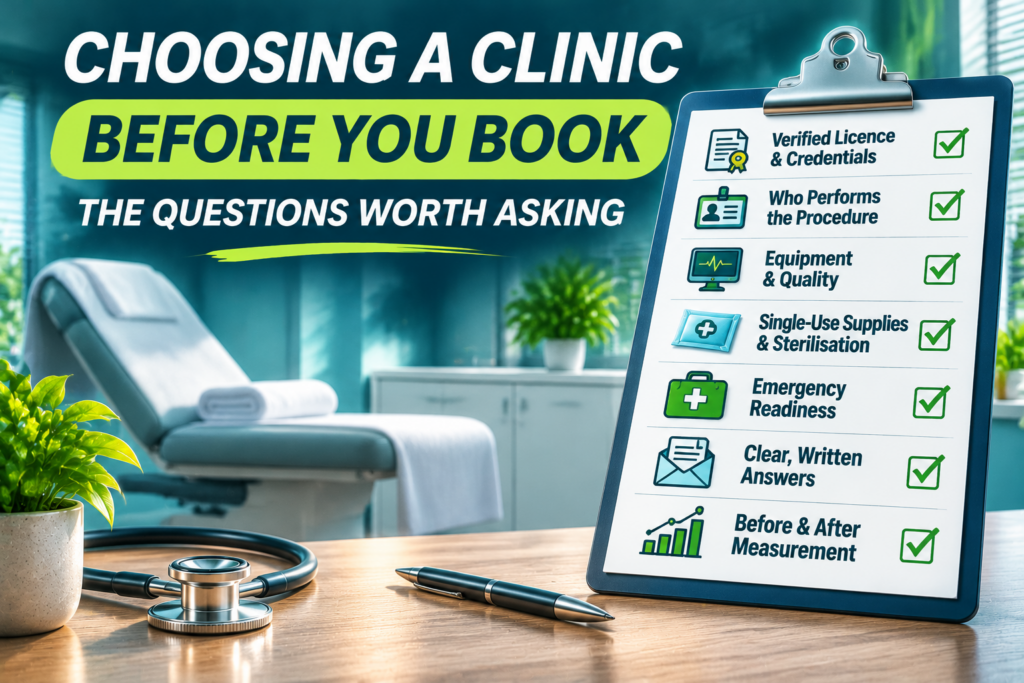
By Dr. Chris Cormier, DC — EBOO Prime We are a clinic, and we are about to hand you the list of questions we would want you to ask a clinic. That is deliberate. Choosing a clinic well is good for you and good for us, because the places that answer these questions easily are the places we are happy to be compared with. Here is the principle that runs through all of it: when you ask a good question, the useful information is in how readily it is answered, not only in the answer itself. A clinic that welcomes the question has told you most of what you needed to know before it says a word. None of what follows requires any medical knowledge. Knowing how to choose a clinic is a handful of plain questions asked in a sensible order, and most of it can be done from your phone before you ever walk in. Start with the licence, because it is the only binary check Almost everything else on this page is a judgement call. This one is not: a licence is either current or it is not. Every state has a regulatory board that licenses clinicians and, in many cases, facilities. Those boards publish online lookup tools that are free and take a couple of minutes. You can confirm that a licence is active, and you can usually see whether there is any disciplinary history attached to it. One specific thing to listen for when choosing a clinic: the difference between licensed and trained. Those words do very different work. A state licence is issued by a public body and can be looked up by you. A certification may represent years of formal study, or a vendor course that ran over a weekend — and from the outside the two look identical on a website. So the question is not “are your staff trained?” It is “which licence does the person treating me hold, and in which state?” That version has an answer you can go and verify. A clinic that is proud of its credentials will give you the numbers without being asked twice. Some publish them on the site, which is the gold standard and saves everybody a phone call. Ask who will actually be in the room This catches more people than any other item here, and it is not a trick question — it is simply an easy detail to assume. The person who gives you the consultation is not always the person who performs the procedure. At larger practices that is often perfectly normal and perfectly safe. But you want to know it in advance rather than discover it on the day. Frequency is the one people forget to ask about, and it is genuinely informative. Somebody who performs a procedure several times a week has encountered the awkward variations. Somebody who does it occasionally may be excellent and may simply have seen less. The consultation is itself the test A good consultation has a particular shape, and once you have seen it you can recognise it anywhere. It starts with your history rather than with the treatment. You should be asked what you are hoping to change, what else is going on with your health, what medication you take. If a clinic recommends something before it has asked those things, it has recommended it to a category of person rather than to you. You should also never be asked to sign a consent form before you have had that conversation. Consent follows the discussion; it does not replace it. The strongest signal of all is a clinic that is willing to tell you no. If nobody is ever turned away, the assessment is not doing any work. We say no reasonably often, and it is not a difficult conversation to have. Somebody for whom this is not appropriate is better served hearing that at the enquiry stage than four sessions in. Bring your full list to that conversation, and make it genuinely full — prescriptions, supplements, powders, drinks, anything you take regularly. People routinely leave the supplements off because they do not feel like medication, and they are exactly the thing a clinician needs to see. The Nerve Health Institute wrote about why that matters more than most people expect in vitamin B6 toxicity and nerve symptoms, and the same principle applies in any consultation: the clinician can only work with what you put on the table. Our companion pages on this are questions to ask before a procedure, which covers the treatment itself, and what to tell your doctor before a procedure, which covers the conversation in the other direction. Equipment, consumables and cleanliness This is a fair question and a good clinic answers it without any defensiveness at all, so do ask it. The visual check costs nothing while you are there. Rooms should be uncluttered and organised, surfaces disinfected between patients, sharps containers present and properly used, gloves changed between steps. None of that requires expertise to notice. Watching single-use items come out of sealed packaging in front of you is the simplest reassurance available in any clinical setting, and it is entirely normal to expect it. Nobody competent is offended by a patient paying attention. Ask what happens if something goes wrong This is the most useful question on the page and the one almost nobody asks, because it feels impolite. It is not impolite. It is the question a clinic should most want to answer, and the reaction to it tells you a great deal when you are choosing a clinic. Ask for those answers in writing. Not because anybody is expecting trouble, but because a clinic that has thought this through already has the answers written down somewhere, and one that has not will discover that while you wait. The written-answer test Here is a quiet, effective check that takes one email. Once you are seriously choosing a clinic, send your questions in