By Dr. Chris Cormier, DC — EBOO Prime
Search for help with bladder leaks or waking up at night and you will find the same answer everywhere: do your Kegels. That answer is correct, and it is only half of the picture.
Because a muscle does not get stronger from contractions alone. It gets stronger from contractions plus the blood supply that lets it recover and rebuild — and the pelvic region is one of the easiest places in the body for circulation to quietly decline. This is the half of pelvic health that almost nobody addresses, and it is the half we work on at EBOO Prime.
Why muscle training needs blood supply
Here is the sequence that turns effort into strength.
You contract a muscle. That creates a demand signal. The muscle then needs oxygen delivered, fuel delivered, metabolic by-products carried away, and raw materials brought in to repair and build tissue. Every one of those steps happens through the microcirculation — the smallest vessels, the ones that actually reach the muscle fibres.
When that delivery system is working well, training produces results. When it is sluggish, you can do everything right and progress slowly, which is exactly the frustration we hear from people who have been doing their exercises diligently for months.
Your nerves need blood too
This part matters just as much for bladder control. Nerves have their own dedicated blood supply — tiny vessels called the vasa nervorum that feed the nerve itself. The sacral nerves running down to the pelvic floor and bladder depend on that supply to carry signals cleanly.
So pelvic floor function is really a three-part system: the muscle, the nerve that drives it, and the circulation that keeps both alive. Train the muscle and ignore the other two, and you are working at a fraction of your potential.
Where circulation quietly declines
A few patterns show up again and again:
- Long hours seated. Sustained sitting compresses the pelvic region and reduces local blood flow for hours at a stretch — and most of us now do this for a living.
- Metabolic strain. Blood sugar and metabolic health have a direct relationship with microvascular function, and the smallest vessels are affected first.
- Low overall movement. Microcirculation is use-dependent. Vessels that are regularly asked to deliver stay better at delivering.
- Age and accumulated oxidative load. Vessel flexibility and delivery efficiency change over the years, which is why the same exercise routine produces different results at 30 and at 60.
The encouraging part: microvascular function is responsive. Research on exercise training and microvascular function shows the small-vessel network adapts to being used — which means the circulation side can be improved, not just accepted.
What EBOO is
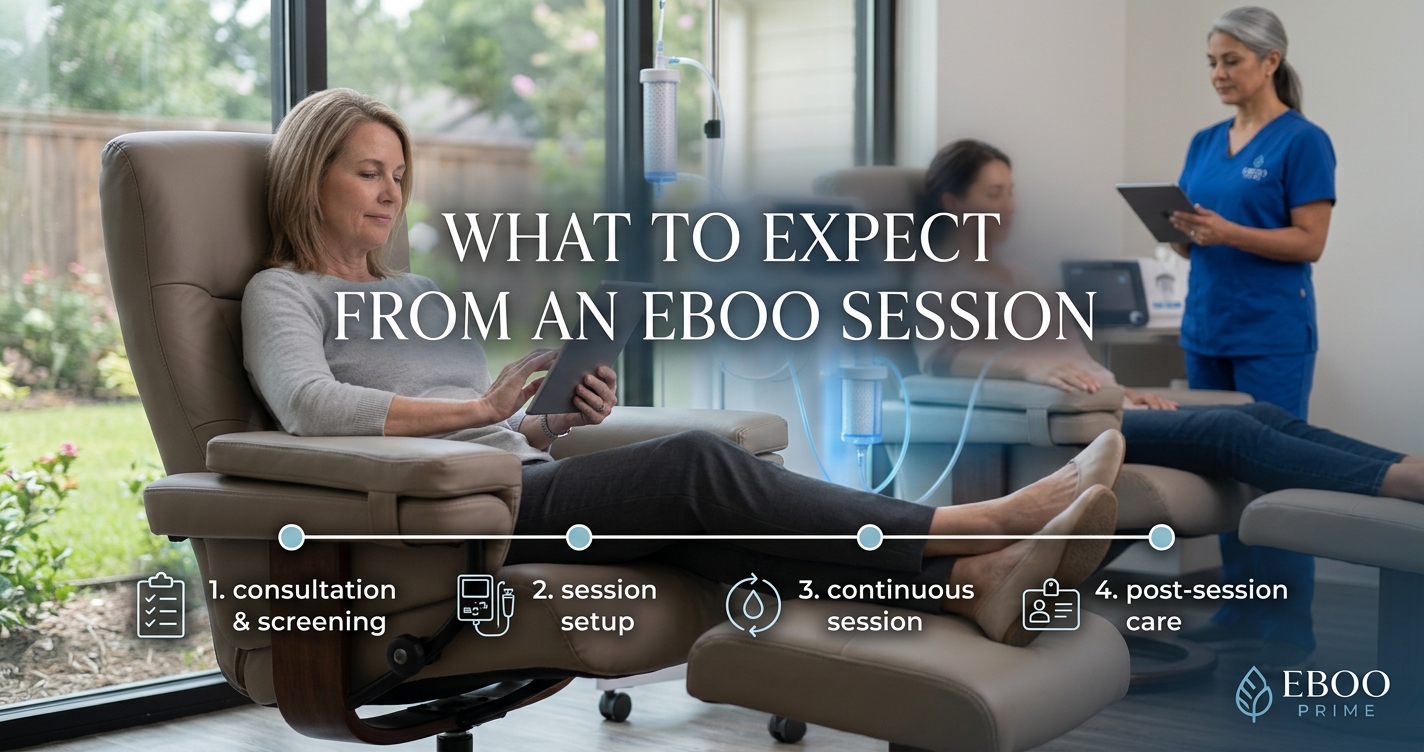
EBOO stands for extracorporeal blood oxygenation and ozonation. In a session, blood is drawn from one arm, passed through a specialised filter and oxygenation circuit, and returned through the other arm in a continuous loop over the course of the treatment.
It is the most thorough form of oxygen-based therapy we offer, and it sits at the centre of how we think about the delivery side of health. Full detail on the procedure is on our what is EBOO and how it works pages.
We describe EBOO as a supportive wellness therapy focused on circulation and oxygenation, used alongside the rest of someone’s plan rather than as a treatment for any specific condition. We are deliberate about that language — it reflects how the therapy is positioned, and it means the conversation at your consultation is an honest one about what we are working on together.
The muscular half: where the pelvic floor work actually happens
Circulation support is one side. The pelvic floor itself still has to be trained, and there are two routes depending on where you are.
At home, starting tonight
A properly structured home programme is free and effective, and for most people it is the right place to start. Finding the contraction correctly, pairing the lift with your exhale, getting fluid timing right. Our full four-week programme is at BodyCharger.
In clinic, for volume you cannot produce voluntarily
At The Nerve Health Institute in Lafayette, the EMSELLA chair uses focused electromagnetic energy to produce 11,200 complete pelvic floor contractions in a 28-minute session, seated and fully clothed. In the published multicentre study of 75 women, 81.33% reported significant symptom improvement after a six-session course, with pad use down 53.68% at three-month follow-up. The full detail is in the clinic’s EMSELLA article.
Put the two halves together — train the muscle, support the delivery system — and you are working with the whole system rather than one piece of it.
Supporting circulation between sessions
Plenty of this is in your own hands, costs nothing, and works whether or not you ever come in for a session. If you take one thing from this page, take this list.
Break up sitting every 30 to 45 minutes
You do not need a workout — you need interruption. Stand, walk for two minutes, do ten slow squats or simply shift position. The pelvic region responds to being decompressed and moved, and brief frequent breaks do more for local blood flow than one long session at the end of a sedentary day.
Add short bursts that raise your heart rate
Brisk stairs, a fast walk up a hill, carrying shopping without stopping. A few one-minute efforts spread through the day push blood through the small-vessel network and keep it responsive. This is the simplest form of microvascular training there is.
Breathe to move blood, not just air
Slow diaphragmatic breathing changes pressure in the abdomen and assists venous return from the lower body. Four counts in through the nose, six counts out, ten breaths, twice a day. It also shifts you toward the parasympathetic side of your nervous system — the side that handles repair.
Hydrate properly and keep moving warm
Blood volume and viscosity both depend on hydration, so steady fluid intake through the day supports delivery directly. Warmth helps too — gentle heat encourages vessels to open, which is one reason people often feel looser and move better after a warm shower.
All of this sits inside the wider at-home system we teach at BodyCharger, alongside the pelvic floor work itself.
How we sequence it: the OWL Method
Our framework across all three practices is oxygen, water and light, supported by frequency, magnetism and nutrients. Oxygen comes first for a reason — it is the primary ingredient in every one of your roughly 30 trillion cells, and no amount of training, nutrition or recovery work compensates for a delivery problem.
In practice that means we look at the delivery side early rather than treating it as an afterthought once a training programme has stalled. Oxygen and circulation first, then the muscular work, then the lifestyle inputs that hold the result.
Is EBOO right for you?
Most people who enquire are suitable, and the consultation is straightforward. We review your history properly first, and there are some situations where we would recommend a different path or ask for clearance from your physician before proceeding.
Bring details of any bleeding or clotting disorders, blood-thinning medication, recent surgery, active infection, pregnancy or breastfeeding, significant cardiac or respiratory conditions, current cancer treatment, and any implanted devices. Also bring a full list of your medications and supplements. We will go through all of it with you and confirm the right approach.
Whatever the outcome of that conversation, the pelvic floor training above remains fully available to you — at home for free, or in clinic if you can reach Lafayette.
Frequently asked questions
What is EBOO therapy?
EBOO — extracorporeal blood oxygenation and ozonation — is a therapy in which blood is drawn, passed through a filter and oxygenation circuit, and returned to the body in a continuous loop. We offer it as a supportive wellness therapy focused on circulation and oxygenation. Our FAQ page covers the practical questions about sessions.
How does circulation affect pelvic floor strength?
Muscle adapts to training through the delivery of oxygen and nutrients and the clearance of metabolic by-products, all of which happen through the microcirculation. Nerves have their own small-vessel supply as well. So the quality of blood flow to the pelvic region influences how much benefit you get from the exercises you are doing.
Should I do pelvic floor exercises as well?
Yes — the exercises are where the strength is built. The circulation side supports that work rather than replacing it. Start with the at-home programme and add in-clinic treatment if you want to accelerate.
How long is an EBOO session?
Sessions typically run between one and two hours depending on the protocol, and you are seated and comfortable throughout. Specifics are covered at your consultation and on our how it works page.
Can I combine EBOO with the EMSELLA chair?
Many patients do exactly that, since the two address different halves of the same system. Both are available through the Dr. Chris Cormier network — enquire here and we will map out a sequence that suits your situation.
Start the conversation
If you have been doing the exercises and want to work on the delivery side as well, enquire with EBOO Prime and we will talk through whether it fits your plan.
Dr. Chris Cormier, DC
Founder, EBOO Prime, The Nerve Health Institute and BodyCharger
In-clinic care at nervehealth.com. At-home programmes at bodycharger.com. More on how we practise at drchriscormier.com.
Spark your cells to optimal longevity.