By Dr. Chris Cormier, DC — EBOO Prime
People ask me what EBOO is and I can answer that in a sentence. What they actually want to know is different, and almost nobody describes it properly anywhere:
What is the hour like? Does it hurt? What happens afterwards?
So this page is the honest walkthrough, start to finish. If you are considering it, this is what you are considering.
Before anything is booked
The first step is a conversation, not a scheduling link.
EBOO involves IV access in both arms, which makes it a medical procedure, and medical procedures are matched to individuals rather than ordered from a page. Our nurse — who has 25 years in practice — screens every prospective patient against a full list of contraindications before anything is arranged. Certain medical histories, certain conditions, and circumstances affecting the arms and veins all come into that assessment.
Sometimes the answer is that it is not the right fit, and we will tell you so. I regard that as one of the best things about how we run this — a clinic that will say no is a clinic worth believing when it says yes.
This is also where we go through your wider picture: what else you have going on, what you are already doing, and whether this makes sense alongside it.
The hour itself
The chair
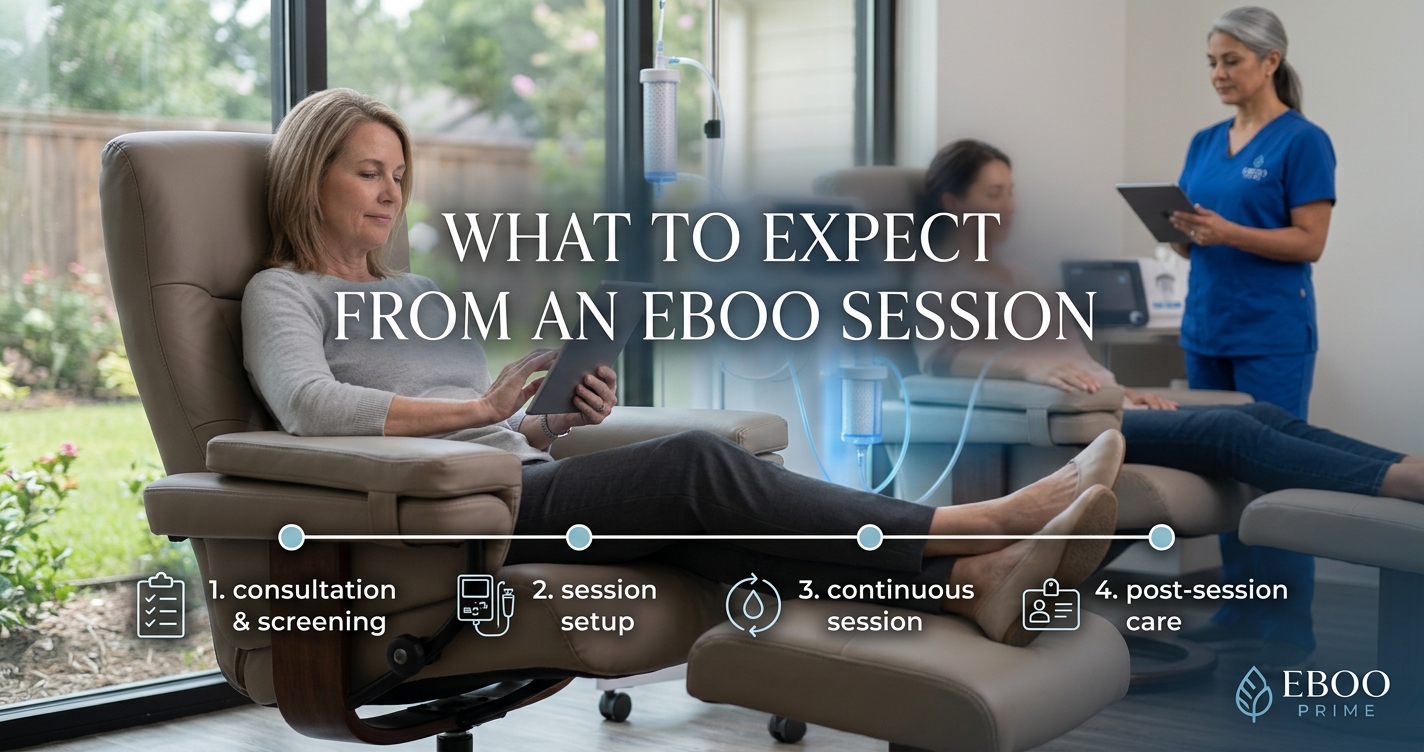
You sit. The chairs were chosen specifically for this, with arm supports and raised legs, because an hour in the wrong chair is an entirely different experience from an hour in the right one. That sounds like a small detail and it is not.
The lines
A nurse places an IV line in one arm and another in the opposite arm. Blood leaves from one side, travels through the circuit, and returns on the other. It is a continuous loop rather than a draw-and-return, which is why you sit through it rather than wait for it.
The technical description of the circuit — the filter, the oxygenation and ozonation stage — is on our what is EBOO and how it works pages.
Watching it
The whole loop is visible while it runs. Most people expect to find that unsettling and end up finding it the opposite — there is something reassuring about being able to see the process rather than having it happen out of sight.
Patients tend to watch for the first ten minutes and then stop noticing.
How long, and how much
About an hour for the session, with time either side.
A session processes roughly two litres. The average adult has around six. We work in increments rather than attempting everything at once, and that is a deliberate decision rather than a limitation — staged is the right way to do this.
Does it hurt? The honest answer
I am going to answer this personally, because the textbook answer is useless to someone who is nervous.
I do not like needles. I was uneasy before my own first session, and I say that openly to patients who tell me the same thing — it is a very common thing to feel and there is nothing odd about it.
What actually happens is that the line placement takes a moment, and then it is over, and then you are sitting in a comfortable chair with nothing being asked of you for an hour. Most people describe the session itself as restful. An hour where you have nothing to do is not a bad hour.
Our nurse does this all day and is very good at it, which makes more difference than anything else on this page.
Afterwards
People ask what they should expect to feel, and I would rather set a realistic frame than an inflated one.
Responses vary. Some people notice something soon afterwards and some do not, and neither of those is a sign of anything in particular. What I can tell you with confidence is what makes the difference afterwards, because it is consistent: what you do in the following weeks.
A session is a single intervention in an ongoing life. Someone who sleeps well, hydrates, moves and breathes properly is in a different position from someone who does none of those — and that is not a disclaimer, it is the most useful thing I can tell you. The at-home side of that is on BodyCharger, and it is where I send everyone.
How often, and how many
That is decided individually and it is part of what we discuss at consultation.
Because a session processes a portion of your blood volume rather than all of it, EBOO is generally approached as a planned sequence rather than a single event. What that sequence looks like depends on you — your history, your situation, and what else you are doing.
Anyone offering you a fixed number before meeting you is guessing.
The blood oil change
This is the shorthand I use and people remember it, so it is worth explaining properly.
Run an engine long enough without changing the oil and the oil stops doing its job — not because the engine is broken, but because the medium everything depends on is carrying more than it should.
Blood is a transport medium, and that is not a metaphor. The National Library of Medicine puts it plainly: blood “transports oxygen and nutrients to body tissues and returns waste and carbon dioxide,” and it “distributes nearly everything that is carried from one area in the body to another.”
Everything. In both directions. That is why we pay attention to it — and it is why circulation and oxygenation sit at the centre of this brand rather than at the edge of it. We went into the delivery side in circulation and pelvic floor health and the demand side in why the brain needs oxygen.
The metaphor is a way of remembering why the medium matters. It is not a description of what the equipment does, and we would rather be precise about that than clever.
What we will tell you at consultation
Three things, every time, because they are true and because knowing them in advance makes the conversation better.
One: what this is
EBOO is a supportive wellness therapy focused on circulation and oxygenation. It belongs in a wider picture alongside training, nutrition, hydration, light and sleep.
Two: what it is not
It is not a treatment for any diagnosed disease, and it is not a substitute for care you are receiving elsewhere. If you have a condition under management, keep managing it — and tell us about it, because it is part of the assessment. If you have symptoms that have not been looked at, see a physician first. That order matters.
Three: what actually moves the needle
The unglamorous things, every time. Sleep, breathing, hydration, light, movement. We cover the first of those in oxygen and sleep, and the rest is on BodyCharger.
A clinic that tells you the free things matter most is a clinic you can trust about the paid ones. Our FAQ page takes the same line on everything else people ask us.
Where it sits in the wider approach
Our framework is six ingredients in order: oxygen, water, light, then frequency, magnetism and nutrients. What took me years to articulate is that there is a seventh consideration sitting alongside all six, and it is not an ingredient at all.
Replenishing works better when there is room for it to work.
That is where this fits. Not instead of the six and certainly not as a shortcut past them — as the step that makes the rest of the work easier.
Where nerve function, chronic pain or autonomic balance are the live question, that is clinical work at The Nerve Health Institute. More on how and why I practise this way is at drchriscormier.com.
Frequently asked questions
What should I expect from an EBOO session?
A consultation and screening first, then an hour seated in a supported chair with an IV line in each arm while blood circulates through the external circuit and returns. You can watch the whole thing. A session processes around two litres, and we work in increments rather than all at once.
Does EBOO hurt?
The line placement takes a moment and then it is done. Most people describe the session itself as restful. I am not fond of needles myself and found it far easier than I expected — our nurse has 25 years of practice and that makes the difference.
How long does an EBOO session take?
About an hour, plus time either side for setup and finishing.
How many sessions will I need?
That is decided individually at consultation. Because each session processes a portion of your blood volume, EBOO is approached as a planned sequence rather than a one-off. Anyone quoting a number before meeting you is guessing.
Who can have EBOO therapy?
Adults, following screening. Our nurse assesses every prospective patient against a full list of contraindications before anything is scheduled, and sometimes the outcome is that it is not the right fit.
Will I feel different afterwards?
Responses vary and neither outcome means anything in particular on its own. What is consistent is that what you do in the weeks afterwards matters — sleep, hydration, movement and breathing are what make any of this hold.
Is EBOO a treatment for a specific condition?
No. It is a supportive wellness therapy focused on circulation and oxygenation, not a treatment for any diagnosed disease and not a substitute for care you are receiving elsewhere. If you have symptoms that have not been assessed, see a physician first.
Start with the conversation
If you have read this far, the next step is not a booking — it is a conversation where we go through your actual situation and tell you straight whether this fits it. Make an enquiry.
Dr. Chris Cormier, DC
EBOO Prime — circulation and oxygenation, clearly explained