By Dr. Chris Cormier, DC — EBOO Prime
Your body already has a remarkable filtration system. Your kidneys process about 180 litres of plasma a day — reabsorbing roughly 178.5 litres and producing around 1.5 litres of urine — and to do it they take a quarter of everything your heart pumps.
That is the context people usually arrive with when they ask about EBOO. So let me give a clear, specific answer to what it is, what it is for, and who it suits — because specificity is what makes any claim worth something, and vague answers in this field help nobody.
What EBOO is
EBOO stands for extracorporeal blood oxygenation and ozonation.
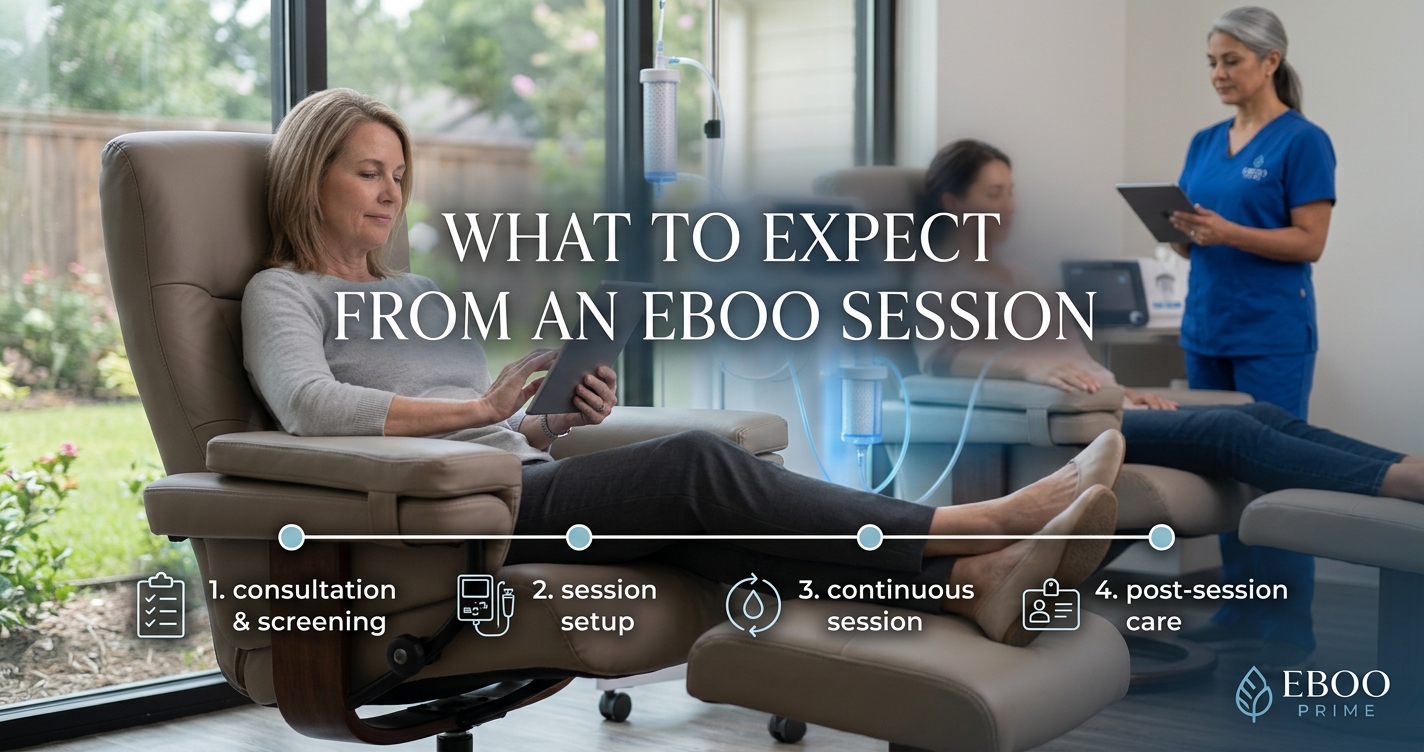
In a session, blood is drawn from one arm, passed through a specialised filter and oxygenation circuit, and returned through the other arm in a continuous loop over the course of the treatment. You are seated and comfortable throughout, and sessions typically run between one and two hours depending on the protocol.
It is the most thorough oxygen-based therapy we offer, and the full procedural detail is on our what is EBOO and how it works pages.
What it is for — and what it is not
Here is the part I want to be completely direct about, because people searching this topic deserve a straight answer.
We offer EBOO as a supportive wellness therapy focused on circulation and oxygenation, used alongside the rest of someone’s plan.
It is not a treatment for kidney disease, and it does not do the job your kidneys do. It is not a substitute for dialysis, and it is not an alternative to nephrology care. If you have kidney disease, your nephrologist manages it — and if dialysis has been recommended for you, that is life-sustaining treatment and your medical team is who you discuss it with.
I state that plainly for two reasons. The first is that it is accurate. The second is that a clinic that tells you exactly what its therapy is not is a clinic you can trust about what it is. Anyone in this field offering you a blood-based therapy as an answer to an organ condition is telling you something they cannot support.
The side we do work on
What EBOO Prime is built around is the delivery side of health — circulation and oxygenation — and that matters for reasons that have nothing to do with replacing an organ.
Oxygen is the first ingredient
Oxygen is the primary requirement of every one of your roughly 30 trillion cells. Organs with high metabolic demand are the most sensitive to how well it is delivered, and the kidneys are among the hungriest consumers you have — a quarter of cardiac output is not a background detail.
Delivery depends on the whole system
Oxygen reaching tissue is not one thing. It depends on breathing, on circulation reaching the smallest vessels, on hydration, and on how efficiently blood moves. When any part of that chain is sluggish, every tissue downstream is working on reduced supply — which is why we treat delivery as something to assess rather than assume.
It is one input among several
Our framework is oxygen, water and light, supported by frequency, magnetism and nutrients. EBOO sits in the oxygen column. It is not the whole plan and it is not the first thing most people need — which is why the two sections below matter more than this one for the majority of readers.
What supports your own filtration system every day
If you want to support the organs that do your filtering, the daily inputs do more than anything we offer here — and they cost nothing.
- Steady hydration through the day rather than catch-up drinking, tapering in the last two to three hours before bed.
- Sodium awareness, which mostly means cooking more of your own food rather than watching the salt shaker.
- Daily movement and breaking up long sitting, because circulation is use-dependent.
- Morning daylight and protected sleep, since kidney filtration and blood pressure both follow a daily rhythm.
- A look at your medicine cabinet, particularly how often you reach for over-the-counter anti-inflammatories — a two-minute conversation with your pharmacist is worth having.
The full daily routine is set out at BodyCharger, our at-home platform. Start there.
One number that is personal to you
For people with diagnosed kidney disease, fluid targets are individualised and set by the nephrology team. In earlier stages the guidance is usually to drink freely; in later stages a specific limit is prescribed and it matters.
So if you are under kidney care, your number comes from your team rather than from any article, including this one. We ask about it at consultation for the same reason.
The factor worth having checked
Two things are worth knowing about that sit outside both the daily routine and anything we offer here.
The first is testing. Two simple tests — eGFR, a blood test estimating kidney function, and uACR, a urine test checking for kidney damage — give you the picture, and early changes are typically silent. Ask your physician, particularly if you have diabetes, high blood pressure or a family history.
The second is the nerve supply. Every cell in an organ is connected back to the brain, and the nerves serving the kidneys emerge from the lower back. At The Nerve Health Institute, the primary nerve to the kidneys is among the most commonly compromised findings in patients who come in, assessed directly through the 88-nerve assessment. The full explanation is in the clinic article on kidney health.
Who EBOO suits
Most people who enquire are suitable, and the consultation is straightforward. We review your history properly before anything else, because candidacy here is genuinely individual.
Bring details of any bleeding or clotting disorders, blood-thinning medication, recent surgery, active infection, pregnancy or breastfeeding, implanted devices, current cancer treatment, and a full list of your medications and supplements. Significant cardiac conditions and advanced kidney disease need a different conversation — that is exactly the sort of thing we work through properly rather than assume, and sometimes the right answer is that this is not the therapy for you right now.
Whatever that conversation concludes, everything in the daily routine above stays available to you.
Frequently asked questions
What does EBOO therapy actually do?
EBOO draws blood from one arm, passes it through a filter and oxygenation circuit, and returns it through the other arm in a continuous loop. We offer it as a supportive wellness therapy focused on circulation and oxygenation, used alongside the rest of someone’s plan rather than as a treatment for any specific condition. Our FAQ page covers the practical questions about sessions.
Does EBOO treat kidney disease or replace dialysis?
No. EBOO is not a treatment for kidney disease, it does not perform the function your kidneys perform, and it is not a substitute for dialysis or for nephrology care. Kidney disease is managed by your nephrologist, and dialysis, where recommended, is life-sustaining treatment to discuss with your medical team.
How long is an EBOO session?
Typically between one and two hours depending on the protocol, seated and comfortable throughout. Specifics are covered at consultation and on our how it works page.
What should I do first if I am worried about my kidneys?
Two things. Ask your physician for eGFR and uACR, which is the highest-value single action available to you. And start the daily routine at BodyCharger, which is free and does more for most people than any single therapy.
Can EBOO be combined with other treatments?
Many patients use it alongside in-clinic work and their own medical care. We map out a sensible sequence at consultation. You can also read how we approach the circulation side more broadly in our article on circulation and pelvic health.
Start the conversation
If you want to understand whether EBOO fits your situation — including the possibility that it does not — enquire with EBOO Prime and we will go through it properly.
Dr. Chris Cormier, DC
Founder, EBOO Prime, The Nerve Health Institute and BodyCharger
In-clinic care at nervehealth.com. At-home programmes at bodycharger.com. More on how we practise at drchriscormier.com.
Spark your cells to optimal longevity.