How to Check Out a Clinic Before You Book

By Dr. Chris Cormier, DC — EBOO Prime We are a clinic, and we are about to hand you the list of questions we would want you to ask a clinic. That is deliberate. Choosing a clinic well is good for you and good for us, because the places that answer these questions easily are the places we are happy to be compared with. Here is the principle that runs through all of it: when you ask a good question, the useful information is in how readily it is answered, not only in the answer itself. A clinic that welcomes the question has told you most of what you needed to know before it says a word. None of what follows requires any medical knowledge. Knowing how to choose a clinic is a handful of plain questions asked in a sensible order, and most of it can be done from your phone before you ever walk in. Start with the licence, because it is the only binary check Almost everything else on this page is a judgement call. This one is not: a licence is either current or it is not. Every state has a regulatory board that licenses clinicians and, in many cases, facilities. Those boards publish online lookup tools that are free and take a couple of minutes. You can confirm that a licence is active, and you can usually see whether there is any disciplinary history attached to it. One specific thing to listen for when choosing a clinic: the difference between licensed and trained. Those words do very different work. A state licence is issued by a public body and can be looked up by you. A certification may represent years of formal study, or a vendor course that ran over a weekend — and from the outside the two look identical on a website. So the question is not “are your staff trained?” It is “which licence does the person treating me hold, and in which state?” That version has an answer you can go and verify. A clinic that is proud of its credentials will give you the numbers without being asked twice. Some publish them on the site, which is the gold standard and saves everybody a phone call. Ask who will actually be in the room This catches more people than any other item here, and it is not a trick question — it is simply an easy detail to assume. The person who gives you the consultation is not always the person who performs the procedure. At larger practices that is often perfectly normal and perfectly safe. But you want to know it in advance rather than discover it on the day. Frequency is the one people forget to ask about, and it is genuinely informative. Somebody who performs a procedure several times a week has encountered the awkward variations. Somebody who does it occasionally may be excellent and may simply have seen less. The consultation is itself the test A good consultation has a particular shape, and once you have seen it you can recognise it anywhere. It starts with your history rather than with the treatment. You should be asked what you are hoping to change, what else is going on with your health, what medication you take. If a clinic recommends something before it has asked those things, it has recommended it to a category of person rather than to you. You should also never be asked to sign a consent form before you have had that conversation. Consent follows the discussion; it does not replace it. The strongest signal of all is a clinic that is willing to tell you no. If nobody is ever turned away, the assessment is not doing any work. We say no reasonably often, and it is not a difficult conversation to have. Somebody for whom this is not appropriate is better served hearing that at the enquiry stage than four sessions in. Bring your full list to that conversation, and make it genuinely full — prescriptions, supplements, powders, drinks, anything you take regularly. People routinely leave the supplements off because they do not feel like medication, and they are exactly the thing a clinician needs to see. The Nerve Health Institute wrote about why that matters more than most people expect in vitamin B6 toxicity and nerve symptoms, and the same principle applies in any consultation: the clinician can only work with what you put on the table. Our companion pages on this are questions to ask before a procedure, which covers the treatment itself, and what to tell your doctor before a procedure, which covers the conversation in the other direction. Equipment, consumables and cleanliness This is a fair question and a good clinic answers it without any defensiveness at all, so do ask it. The visual check costs nothing while you are there. Rooms should be uncluttered and organised, surfaces disinfected between patients, sharps containers present and properly used, gloves changed between steps. None of that requires expertise to notice. Watching single-use items come out of sealed packaging in front of you is the simplest reassurance available in any clinical setting, and it is entirely normal to expect it. Nobody competent is offended by a patient paying attention. Ask what happens if something goes wrong This is the most useful question on the page and the one almost nobody asks, because it feels impolite. It is not impolite. It is the question a clinic should most want to answer, and the reaction to it tells you a great deal when you are choosing a clinic. Ask for those answers in writing. Not because anybody is expecting trouble, but because a clinic that has thought this through already has the answers written down somewhere, and one that has not will discover that while you wait. The written-answer test Here is a quiet, effective check that takes one email. Once you are seriously choosing a clinic, send your questions in
Chronic Inflammation: Why It Doesn’t Switch Off
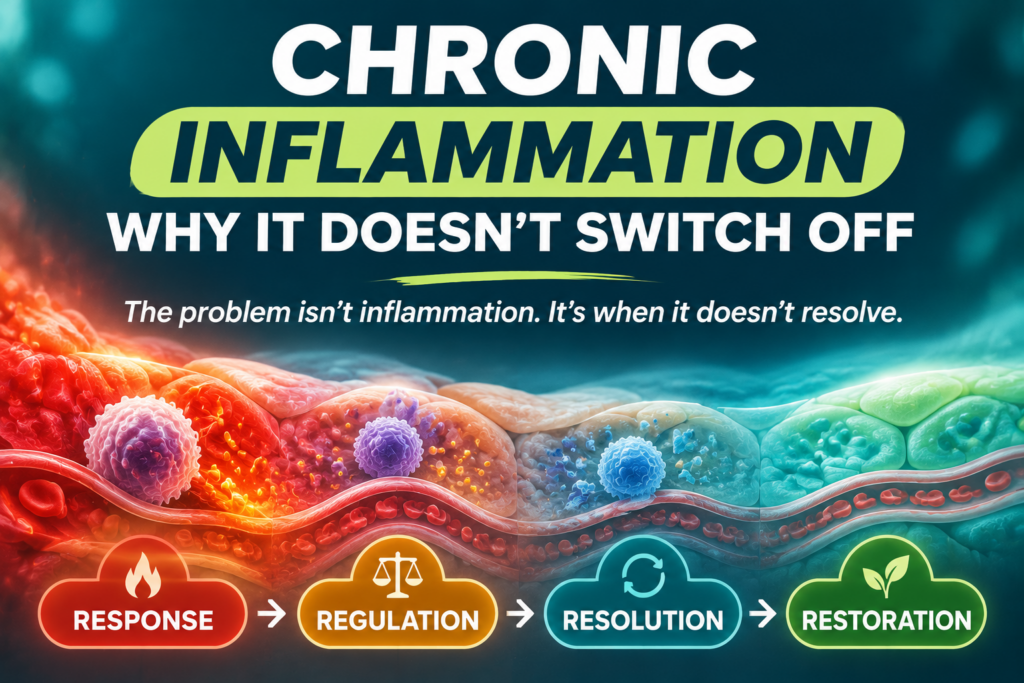
By Dr. Chris Cormier, DC — EBOO Prime Inflammation has become the most blamed word in health. It gets named as the cause of almost everything, which has had an odd effect: a word that explains everything explains nothing. So let us be precise, because the precise version is far more useful. Inflammation is not the problem — it is one of the most sophisticated repair systems your body owns, and you would not survive a week without it. The thing worth your attention is narrower: chronic inflammation — inflammation that started correctly and then never finished. That distinction changes the question you ask. Most people ask how to reduce inflammation. The better question is why a particular inflammation has not resolved. Those are different questions, and the second one is the one that helps. Inflammation is how your body heals Cut your finger. Within minutes you get redness, heat, swelling and tenderness. Those four signs have been described in medicine for two thousand years, and every one of them is a deliberate engineering decision. Redness and heat: blood vessels widen so more blood arrives. Swelling: the vessel walls turn deliberately leaky, so plasma, clotting factors and white blood cells can leave the bloodstream and reach the tissue. Tenderness: nerve endings sharpen, which is how your body tells you to rest that part. None of that is damage. That is a delivery system opening up: white cells arrive, clear the bacteria and the broken tissue, and the repair crew follows. People who cannot mount a proper inflammatory response are in real difficulty. So the goal was never zero inflammation. A body with no inflammatory capacity is a body that cannot heal. The difference is not the inflammation — it is the resolution Here is the part most health content leaves out, and it is the part that makes everything else make sense. For most of the twentieth century it was assumed inflammation ended passively — that the signals which started it simply ran out, like a fire burning through its fuel. That turned out to be wrong. Resolution is now understood as a highly active process in its own right. The body builds and releases a separate class of molecules whose entire job is to bring inflammation to a close and restore the tissue. They are called specialized pro-resolving mediators, and they are built largely from omega-3 fatty acids. Immune cells switch mode, the cells that did the fighting are cleared away, and the vessel walls seal back up. Described in full, the process has four phases: response, regulation, resolution, and restoration — that last one meaning the return of the tissue to its normal, healthy state. Chronic inflammation is what happens when the sequence gets stuck in phase three. The response fired correctly. The off-switch — which is not a switch at all, but an active, built, delivered signal — did not complete. That reframes the whole subject, and it reframes it in your favour. This is rarely a body doing too much. It is usually a body not finishing something — and “not finishing” has causes you can look for. Why chronic inflammation becomes more common with age There is a name for the low-grade, persistent version that accumulates across decades: inflammaging. It describes a low-level inflammatory state that persists in the absence of any infection and tracks with declining function across many tissues. What is striking is exactly where the age-related change sits. In animal research, older animals produce the pro-inflammatory signals at the same levels as young animals. What they do less well is produce the pro-resolving ones. The literature points consistently the same way: ageing is associated with impaired resolution and with less efficient clearance of spent immune cells. Read that carefully, because it is good news dressed up as a technicality. The ageing change behind inflammaging is not that your body becomes more inflamed. It is that your body becomes slower at closing things out. And closing things out is logistics — delivery, clearance, circulation, raw materials, sleep. Logistics can be supported. This is one of the clearest places where the length of your life and the quality of it come apart, which our colleagues at The Nerve Health Institute cover in healthspan vs lifespan. What chronic inflammation feels like Mostly, it does not. This is the single most practical point on the page. Acute inflammation announces itself — red, hot, swollen, sore, in a specific place. The low-grade chronic kind is quiet. There is no reliable sensation that tells you your inflammatory markers are raised. Which means it is measured, not felt. The common markers are C-reactive protein — usually the high-sensitivity version, hs-CRP — and interleukin-6, or IL-6. Both come from an ordinary blood sample. So when someone tells you they can feel their inflammation levels, be gently curious. What people genuinely feel is fatigue, morning stiffness, slower recovery, poorer sleep. All of it is real and worth addressing. None of it is a measurement. If you want to know where you stand, the route is a blood test ordered by a clinician who reads it against everything else about you. We hold our own work to the same standard, which is why we wrote how do you know if a treatment is working. What “anti-inflammatory” actually means The word has become a marketing category, so it is worth separating what is established from what is hopeful. We would rather do that than sell you a certainty we do not have. What is well established is that dietary patterns relate to measured inflammatory markers. A 2025 study from King’s College London, published in the Journal of Periodontology, examined 195 patients who each had a full periodontal assessment, a blood sample and a food questionnaire. Low adherence to a Mediterranean-style diet was associated with the most advanced stages of gum disease, alongside higher circulating CRP and IL-6, and plant-derived food groups showed an inverse relationship with those markers. Notice the shape of
Poor Circulation in the Legs: What It Actually Feels Like
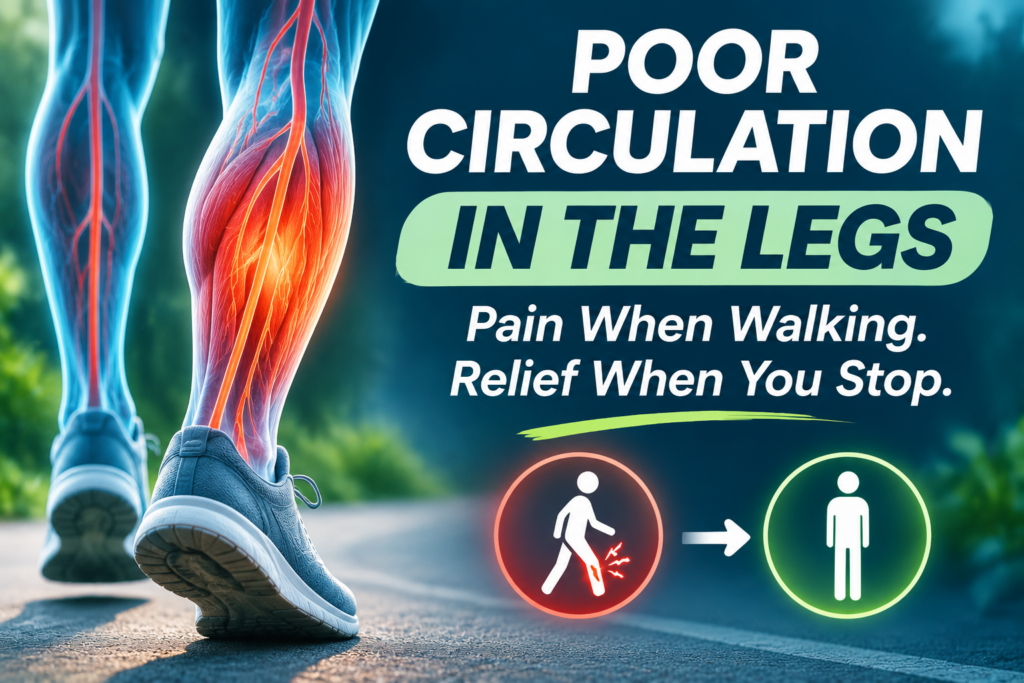
By Dr. Chris Cormier, DC — EBOO Prime We wrote recently that cold hands are usually not a circulation problem — which is true, and the most common question we get asked. This page is the other half of that. There is one leg symptom that genuinely is a circulation problem, it has a very specific pattern, and it is the one most often waved away as getting older. Knowing the pattern takes two minutes to learn, and it is worth knowing. The pattern that matters The classic symptom of poor circulation in the legs is pain that comes on when you walk and goes away when you stop. It is usually described as cramping, aching, burning, heaviness or tightness — most often in the calf, sometimes in the thigh, hip or buttock. It tends to arrive sooner going uphill or climbing stairs, because the muscles are asking for more blood than the arteries can deliver. The medical term is intermittent claudication, from the Latin for limping. The underlying condition is peripheral artery disease — narrowing of the arteries supplying the legs. It is the muscles saying, politely at first, that they are not receiving enough blood to do what is being asked of them. Three tells that separate it from everything else Leg pain is common and most of it is not this. These three features are what point towards circulation rather than something else. 1. The same distance, every time This is the most useful single clue. Circulation-related leg pain tends to come on at a reproducible distance — the same two hundred yards, the same hill, the same point on the walk to the shops. Pain from a back or joint problem is usually far more variable from day to day. 2. Standing still is enough With a circulation cause, simply stopping and standing for a few minutes relieves it. You do not need to sit down, lean forward or change position. That detail genuinely matters, because the main look-alike behaves in the opposite way. With spinal narrowing, standing often brings the pain on, and relief usually requires sitting or bending forward — which is why some people find they can push a shopping trolley much further than they can walk unaided. 3. It is in the muscle, not the joint Circulation pain sits in the meat of the calf or thigh. Joint pain sits in the knee, hip or ankle. Nerve pain tends to be sharp, burning or shooting, often travels down the leg, and does not reliably settle with rest. None of this is a substitute for an examination. It is a way of deciding that the conversation is worth having, which is the whole purpose of this page. The version that hides itself This is the part we find most interesting, and the reason this condition goes unrecognised so often. People adapt around it without noticing. They walk a little less, take the car for short journeys, sit down more, choose the flat route — and because the adaptation is gradual and sensible-feeling, the pain stops happening and the problem stops being visible. Vascular specialists describe patients subconsciously becoming more sedentary as a way of compensating. From the outside it looks like slowing down with age. From the inside it feels like a series of reasonable choices. Neither description mentions the arteries. So a better question than “does my leg hurt?” is: am I walking less than I was two years ago, and do I know why? Dr. Cormier has written about the same pattern from a different angle in my mother had it too — how a decision about what is coming quietly produces the behaviour that makes it likelier. And the version with no pain at all A substantial proportion of people with poor circulation in the legs have no leg pain whatsoever — by some estimates up to four in ten. Other signs worth knowing: That last point about one side is the one we would underline. As we wrote in why are my hands and feet always cold, temperature regulation is even-handed — it cools both feet together. A difference between the two sides is a different question entirely. Who is more likely to have it Roughly one in twenty people over 50 has peripheral artery disease, and the likelihood rises with age. The risk is higher if you: If you have diabetes, there is an additional reason to take leg and foot symptoms seriously: nerve changes can mask the pain that would otherwise be the warning. In that situation, slow-healing wounds matter more than pain does. Why it matters beyond the legs Here is the piece most people are never told. Narrowing in the arteries of the legs usually means the same process is happening elsewhere, so it is a marker of raised risk for heart attack and stroke. Finding it is not only about the legs — it is a prompt to look after the whole cardiovascular system, and that is genuinely useful information to have early. Which is why a symptom that seems minor is worth a conversation. The legs are often the first place the body mentions it. When to act quickly Go to an emergency department now if a leg or foot becomes suddenly painful, pale, cold, numb or weak. A sudden loss of circulation to a limb is a medical emergency and treatment is time-critical. And make an urgent appointment — within days, not months — if you have: Those are signs that circulation has become more seriously limited, and they are treated urgently. Everything earlier on this page is an ordinary appointment rather than an alarming one — but it is an appointment worth making. What happens when you get it checked Reassuringly little, which is worth knowing in advance. Your doctor will ask about the pattern — how far you walk before it starts, what relieves it — and feel the pulses in your feet. The first-line test is the ankle-brachial
How Do You Know If a Treatment Is Actually Working?
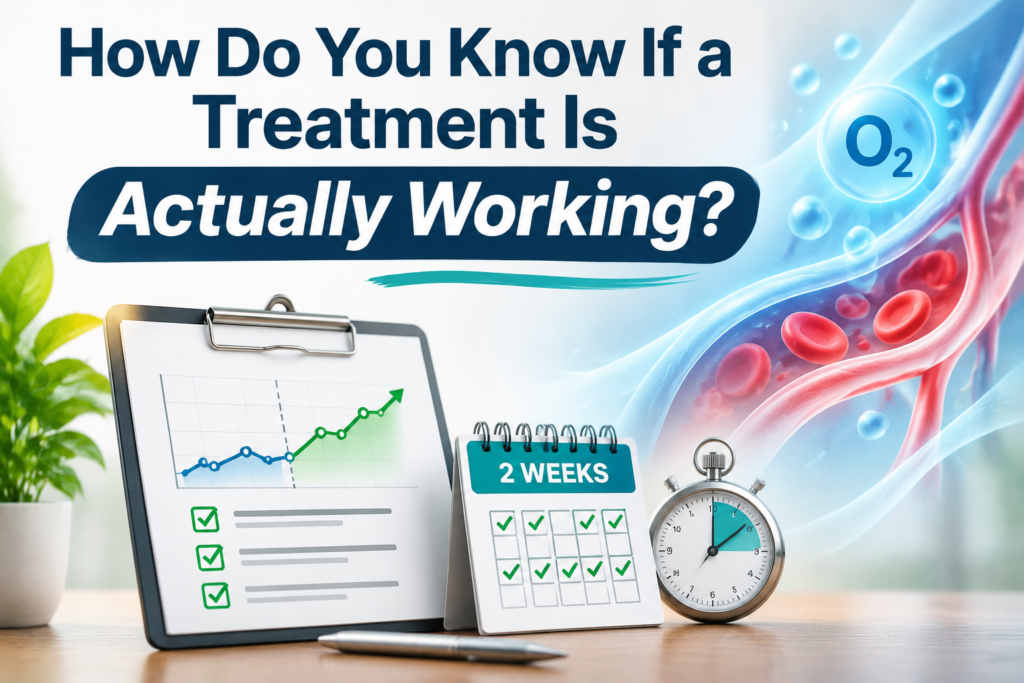
By Dr. Chris Cormier, DC — EBOO Prime How do you know if a treatment is working? We sell one, so you can take this article two ways — and I would rather you took it the second. Anybody spending money on their health deserves a way of telling whether it is doing anything — including when the treatment in question is ours. What follows is the method we would want a member of our own family to use, applied to us as readily as to anybody else. Why knowing whether a treatment is working is harder than it sounds Three things make it genuinely difficult to tell whether a treatment is working, and none of them involve anybody being dishonest. 1. You start treatments when you feel worst This is the big one, and it has a name: regression to the mean. Most symptoms fluctuate. You do not book an appointment on an average week — you book it during a bad one, usually at or near the peak. From a peak, the most likely direction is down, with or without treatment. So almost any intervention started at your worst moment will appear to work. Some researchers think this accounts for more apparent improvement than the placebo effect does. 2. Conditions improve on their own A great many things that bring people to any practitioner are self-limiting. They come and go. As one review of this problem puts it, a condition that naturally waxes and wanes gives both patient and practitioner repeated opportunities to credit a treatment that did nothing. 3. Expectation produces real effects Placebo effects are not imaginary and they are not a failure of character. Context, expectation and the experience of being cared for produce measurable changes in how people feel and function. Which is fine — feeling better is the point. You just want to know which thing you are paying for, because one of them is considerably cheaper to obtain elsewhere. None of this is a reason to be cynical about treatment. It is a reason to measure properly, which almost nobody does. How to tell whether a treatment is working, in six steps Step 1: Decide what you are measuring before you start This is the step that does almost all the work, and skipping it is why most people never really know. Chosen afterwards, the measure will always be whatever happens to have improved — not through dishonesty, but because memory reorganises itself around the outcome. Write it down before session one. On paper, dated. Step 2: Pick something countable “Feeling better” cannot be assessed. These can: One or two of these. Not twelve — tracking everything becomes its own burden and tells you less, not more. Step 3: Get a baseline first Two weeks of measurement before you start anything. This is the step people hate, and it is the one that makes the rest meaningful — without it you are comparing against memory, and memory is the least reliable instrument you own. A baseline also shows you your own range. Most people are surprised by how much they fluctuate anyway. Step 4: Set a review date and a decision rule Before you begin, write two things: when you will review, and what result would make you continue. By 15 March I will have had six sessions. If I am not sleeping through at least two more nights a week than my baseline, I stop and reconsider. That sentence is worth more than any amount of intuition, because you write it while you are still capable of being objective — before you have invested money, time and hope. Step 5: Change one thing at a time The usual pattern is to start a treatment, three supplements, a new sleep routine and a diet change in the same fortnight. If things improve, you have learned nothing about any of them — and you will probably keep paying for all five. One change, long enough to read, then the next. Step 6: Review honestly, including the option to stop Go back to the paper. Compare like with like. Be specifically suspicious of the thought “it must be working somehow” — that is usually the sound of money already spent looking for a justification. What makes a good measure That last point is the one worth keeping. The strongest evidence that something is working is usually something you have started doing again — the walk you stopped taking, the stairs you used to avoid, the evening you no longer write off. Dr. Cormier has written about the limits of measurement in the machine I keep wishing for. Questions worth asking any practitioner, including us Ask these before you start. The answers tell you a great deal, and so does the manner in which they are given. The third one is the most revealing question you can ask anybody in this industry. A practitioner with a clear answer has thought about where their work ends. A practitioner who cannot imagine circumstances in which you should stop is telling you something important, however warmly they say it. We would answer all five, and our page on questions to ask before a procedure sets out more. Dr. Cormier has written candidly about the professional temptation on the other side of that conversation in the most flattering thing a patient can say. One important exception None of this applies to medication prescribed by your doctor. Many prescribed treatments work without producing any sensation at all — blood pressure medication, statins and thyroid treatment usually feel like nothing. “I do not feel different” is not evidence that they are not working. Never start, stop or change a prescribed treatment based on a self-assessment. Speak to your prescriber. This matters enough to repeat in plain terms. The method on this page is for elective treatments you are choosing and paying for — therapies, supplements, programmes, devices, and services like ours. It is not a tool for auditing your prescriptions.
How to Cope While Waiting for Test Results
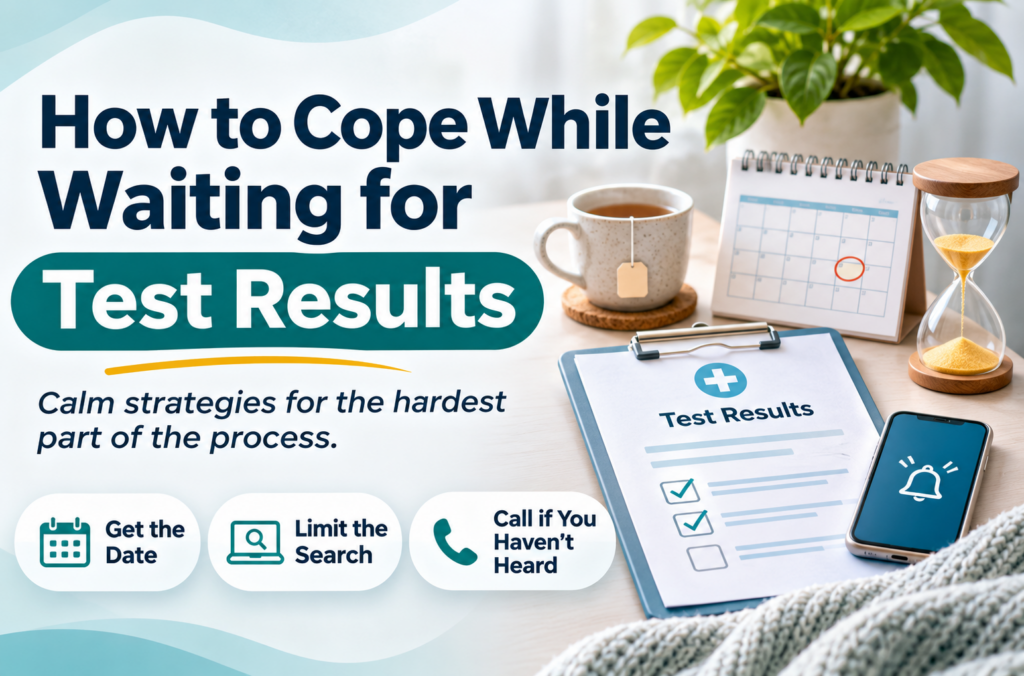
By Dr. Chris Cormier, DC — EBOO Prime The test takes twenty minutes. The wait takes a week, and nobody prepares you for it. We write a good deal here about getting ready for a procedure and getting through one. The gap between the test and the result is the part people are least prepared for, and in many cases it is the hardest part of the whole experience. This page is about that gap. It is not just you, and it is not weakness There is a reasonable body of psychological research on high-stakes waiting, and its central finding is one most people find oddly comforting. Researchers who study waiting periods have found that uncertainty tends to cause more anxiety and distress than facing difficult news does. That is not a figure of speech. When you receive news, however unwelcome, you have something to act on — appointments, decisions, a plan. While you are waiting, there is nothing to do but hold every possible outcome in your head at once. Bad news gives you a problem to solve. Waiting gives you every problem at once, and no way to start on any of them. So if you have found this week harder than you expected, you are experiencing the thing the research predicts rather than coping badly. That is worth knowing on its own. The honest part: most of the usual advice does not work We would rather tell you this than have you feel like a failure for trying it. The three strategies people reach for instinctively are distraction, determined positive thinking, and bracing for the worst. When researchers followed people through long, high-stakes waits and measured how well those approaches worked, none of them reliably reduced distress — and some of them made it worse. Forced optimism in particular leaves people less prepared, and bracing too early simply extends the suffering. What did show a measurable benefit was different in kind: practices that keep attention in the present rather than trying to control what you feel about the future. Mindfulness practice was the first approach shown to help with this specific kind of waiting. Deep absorption in an activity — the state psychologists call flow — also helps, not as distraction but because it is genuinely occupying. And supportive company reliably makes waiting periods easier to bear. The practical translation: stop trying to feel differently about the result, and put your attention somewhere that requires it. How to get through the wait Step 1: Pin down the date before you leave Ask, before you walk out of the room: when will the result be ready, how will I be told, who will contact me, and what should I do if I have not heard by then. Write the date down. A wait with a known end is a different experience from a wait with no edge on it, and this single question changes the shape of the whole week. Our guide to questions to ask before a procedure covers the rest. Step 2: Decide who you are telling One or two people, chosen deliberately. Supportive company is one of the few things research consistently shows makes waiting easier, and the choice matters: you want the person who sits with it, not the one who researches it. Telling nobody is the harder road, and telling everybody means managing other people’s worry on top of your own. Step 3: Give the worry a time and a place Rather than attempting not to think about it, which does not work, give it fifteen minutes a day. Same time, same chair. When it turns up outside that window, you can note it and tell yourself it has an appointment later. This is not a trick to stop the worry — it is a way to stop it occupying the entire day. Step 4: Choose something genuinely absorbing Not scrolling, which leaves room for thinking. Something with enough demand to take your whole attention — cooking something complicated, a long walk somewhere unfamiliar, a practical job you have been putting off, a sport, a game with other people. The test is whether you look up and find an hour has gone. Step 5: Set a limit on searching Everybody looks. Setting a boundary on it beforehand is more realistic than deciding not to. Two rules make a real difference: stick to established medical organisations rather than forums, and do not read survival statistics for a condition you have not been told you have. Those figures are averages across people whose circumstances you do not share, they are usually several years out of date, and at this stage they describe a situation that may well not be yours. Step 6: Plan the appointment, not the outcome Your mind will rehearse scenarios regardless, so give it something useful to rehearse. Write down the questions you would want to ask in either case. Decide who, if anyone, you would take with you. This is preparation rather than catastrophising — and it has a pleasant side effect: a list of questions is a finished task, and finished tasks are quieter than open ones. No news is not good news This section is the practical heart of the page, and it is the one we would most want you to remember. Do not assume that hearing nothing means everything was fine. If you have not heard by the date you were given, call and ask. That is expected, and it is not a nuisance. Patient safety research has looked at this carefully, and the picture is consistent: results occasionally do not reach the patient they belong to. One widely cited study found that around 7% of abnormal results were never passed on — roughly one in fourteen. Health systems have improved their tracking considerably since, and most practices now aim to tell you either way, but the safety advice from patient-safety bodies has not changed: no news is no news. So: if you were told you
Why Are My Hands and Feet Always Cold?
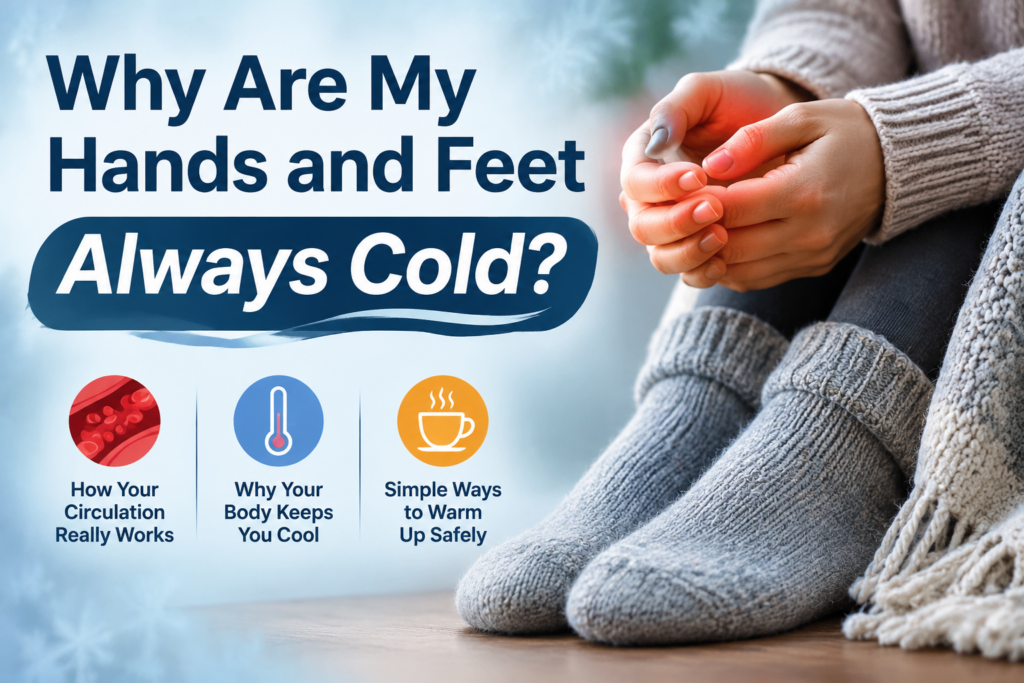
By Dr. Chris Cormier, DC We are a circulation and oxygenation company, so you might reasonably expect this article to tell you that cold hands mean poor circulation. It does not, because for most people that is not what is happening. Cold hands and feet are usually a sign of your temperature control system working exactly as designed — and knowing that is far more useful than being worried about it. Here is what is actually going on, what helps, and the small number of situations where it is worth a conversation with your doctor. The short answer: your body is protecting its core Your body treats core temperature as non-negotiable. The brain, heart and organs need to stay within a narrow range, and everything else is secondary to that. So when you get cold, the nervous system narrows the small blood vessels in your skin, hands and feet. This is called vasoconstriction. Less warm blood travels to the surface, less heat escapes, and the core stays warm. Your fingers and toes pay for it, because they are furthest from the centre and have the most surface area relative to their size. Cold hands in a cold room, on both sides, in somebody who otherwise feels well, are not a fault. They are the system succeeding. The same reflex fires for reasons other than air temperature. Stress and adrenaline trigger it. So do caffeine and nicotine, both of which narrow blood vessels. Sitting still for a long stretch slows blood flow to the extremities. None of that is damage. All of it is reversible. Where circulation actually happens This is the part of the picture most people have never been shown, and it is the part we find most interesting. When people picture circulation they picture arteries and veins — the large vessels, the motorways. But those are just transport. The real work happens in the capillaries, and there are roughly ten billion of them, each so fine that red blood cells pass through in single file. Essentially all exchange between blood and tissue — oxygen out, carbon dioxide back — happens across capillary walls. It works because of surface area: spread across billions of tiny vessels, the exchange surface is enormous in a way a few large vessels could never be. Which means the interesting question in circulation is almost never about the motorways. It is about the last few millimetres. Your fingers and toes are where that fine network is most exposed and most tightly controlled, which is exactly why they are the first thing to go cold and the first thing to warm back up. They are a live readout of a system that is constantly adjusting. Why some people run colder than others There is an enormous normal range here, and most of it is simply how people are built. Blood flow to the hands can vary by a factor of a hundred depending on circumstances. No other tissue in the body swings like that, which makes hands a very sensitive thermometer and a very unreliable diagnosis. How to warm cold hands and feet The useful approaches are not the obvious ones. Step 1: Warm your core, not just your hands This is the one that surprises people. Because peripheral vasoconstriction responds to core temperature, warming your torso often warms your hands faster than gloves do. The old advice holds: if your feet are cold, put a hat on. An extra layer on the body, a warm drink, a blanket over the lap — the body opens the taps to the extremities once it is confident the centre is safe. Step 2: Move, briefly and often Muscle activity drives blood flow. You do not need a workout — a lap of the house, a minute of calf raises at the desk, or a short walk at lunch does more for peripheral circulation than an hour of sitting with the heating up. The win is in the frequency rather than the effort. Step 3: Rewarm gently, not fast When hands or feet are genuinely cold, the safest route is passive rewarming: a warmer room, extra layers, warm (not hot) water. Avoid very hot water and direct heat sources on cold extremities, because cold skin judges temperature poorly and can be burned before it notices. Step 4: Use your breathing Since the same nervous system controls both vasoconstriction and your breath, a few slow breaths with a longer exhale are a genuine lever, not a platitude. Our colleagues at BodyCharger have a simple guide to breathing properly, and more broadly on reducing stress at home. The clinic has written on the physical signs of stress that are worth recognising. Step 5: Look at caffeine and nicotine Both narrow blood vessels. If you are a heavy coffee drinker with persistently cold hands, shifting a cup or two later in the day is a cheap experiment with a quick answer. When it is worth a conversation with your doctor Most cold hands and feet need nothing more than the above. A few patterns are worth having looked at, and the good news is that checking is quick and usually reassuring. Colour changes in clear episodes If your fingers or toes turn white, then blue, then red as they warm up — in distinct episodes triggered by cold or stress, often with tingling or numbness — that pattern has a name: Raynaud’s phenomenon. It is common, it is more frequent in women, and in its usual form it is mild and managed with warmth and avoiding triggers. It is worth mentioning to your doctor, partly to confirm it and partly because occasionally it accompanies something else that is useful to know about. One side, not both Temperature regulation is even-handed — it cools both hands or both feet together. One hand or one foot that is consistently colder than the other is a different question, and that asymmetry is the single most useful thing you can report. The company it
Why You Feel Tired After Eating
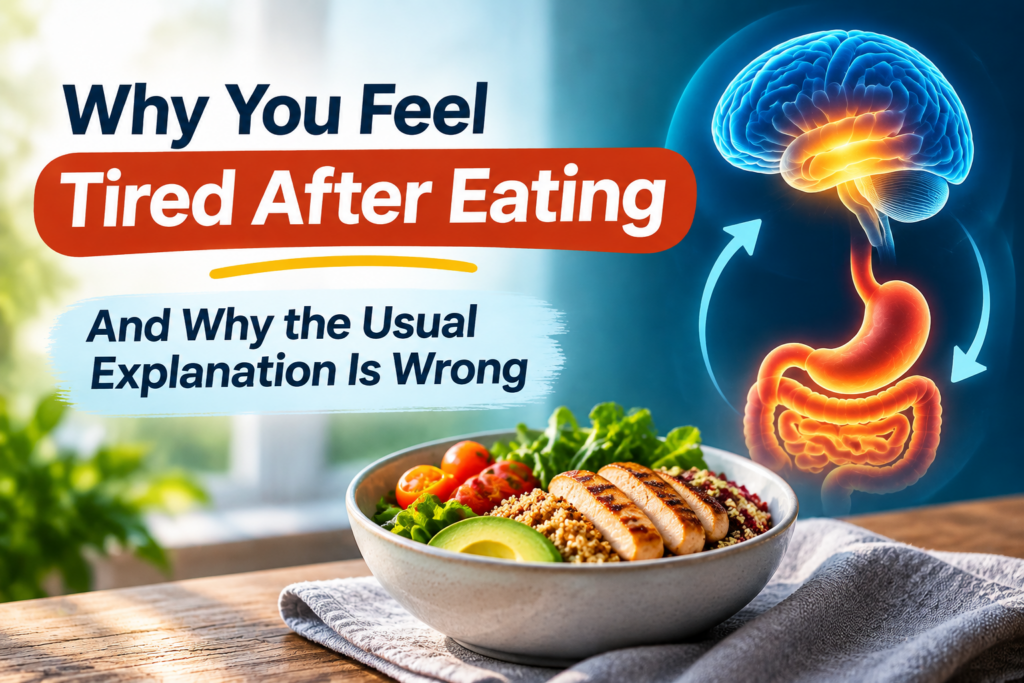
By Dr. Chris Cormier, DC — EBOO Prime Everybody knows the answer to this one. Your blood goes to your stomach to digest, so your brain gets less of it, and you get sleepy. It is tidy, it is intuitive, and it is the most widely believed circulation myth in everyday health. We work in circulation, so correcting it feels like our job. Why the blood-flow explanation does not hold The problem with it is a principle that sits near the centre of how the body manages blood supply. Cerebral perfusion is preferentially maintained. Your brain’s blood supply is defended across an enormous range of states — that is what autoregulation means. During hard exercise, when a very large share of your circulation is redirected to working muscle, flow to the brain is still held steady. The body does not leave the brain short. And when researchers have looked for the supposed post-meal drop, they have not found it. Measurements of flow in the common carotid artery show no meaningful change after eating. The brain is not being starved while you digest. There is a published paper on this question whose title begins with the word “Debunking”, which tells you how settled it is. Blood flow to your gut really does rise after a meal. It simply does not come out of your head. Where the extra blood actually comes from This is the genuinely interesting part, and it is a better story than the myth. Digestion is resource-intensive, and gut blood flow does increase substantially. The body covers that in two ways: by diverting flow primarily from skeletal muscle — tissue that is not doing much while you sit at a table — and by increasing cardiac output, pumping more blood per minute overall. In other words it does not rob one organ to pay another. It reallocates from somewhere idle and raises the total. The wider version of how delivery works is in why oxygen matters for the body. So what is actually making you sleepy? Several things at once, and the honest summary is that the exact mechanism is still being worked out. The leading explanations are chemical and neural rather than circulatory. The vagus nerve and the parasympathetic shift Food arriving in the stomach stretches it, and that stretch signals along the vagus nerve. Eating deliberately moves you onto the rest-and-digest side of the nervous system — which is precisely the side associated with being calm, still and unhurried. A general drop in energy is not a malfunction. It is the state digestion happens in. A large meal eaten quickly distends the stomach more, which signals more strongly. That alone explains a good deal of the difference between a sandwich and a Sunday lunch. Gut-brain hormones Eating triggers the release of a set of gut hormones and neuropeptides that act on the brain, including on the hypothalamus — which happens to be where arousal and sleep centres live. The current thinking is that these signals, along with vagal input, modulate those centres directly. Glucose and the alertness neurons The modest rise in blood glucose after a meal appears to be sensed by neurons in the lateral hypothalamus that produce orexin, one of the chemicals that keeps you awake. Those neurons are inhibited by glucose. Which is a neat and slightly comic arrangement: eating quietly turns down the wakefulness signal. What you ate, and how much Large meals do it more than small ones. High-fat meals are consistently associated with stronger post-meal fatigue, and large carbohydrate-heavy meals amplify it further. And while we are here: the turkey story is not true either. Turkey’s tryptophan content is comparable to chicken and beef and does not raise blood tryptophan more than other common foods. The Thanksgiving nap is the size of the meal, not the bird. What actually helps All of it unglamorous, and all of it free. If the issue is concentration more broadly rather than specifically after meals, that is a different question and it is covered in why can’t I focus. The part that connects to something larger There is a reason this page sits on a circulation and oxygenation site beyond simply correcting a myth about circulation. Digestion is a parasympathetic activity, governed through the vagus nerve. That is the same pathway that makes stress and digestion inseparable — if the alert side of your nervous system is running continuously, the side that handles digestion is getting less of the stage. It is not a metaphor; it is one nerve doing two jobs that compete. That relationship is central enough that irritable bowel syndrome is formally classified as a disorder of gut-brain interaction. The clinical write-up is at The Nerve Health Institute, and the practical day-to-day side at BodyCharger. The related case of stress changing your breathing is in short of breath when stressed. When post-meal tiredness is worth mentioning to a doctor Usually it is ordinary. Sometimes it is a signal, and it is an easy one to check. Raise it with your doctor if the sleepiness after meals is severe, happening most days, or getting worse — and particularly alongside heavy snoring or unrefreshing sleep, unusual thirst or urination, unexplained weight change, persistent fatigue regardless of eating, or feeling cold and run down generally. Those point toward things like sleep apnoea, blood sugar problems, thyroid conditions or anaemia — all common, all straightforward to test for, and all considerably better found than not. Where we sit EBOO is a circulation and oxygenation procedure. We would not offer it for post-meal tiredness and we are not suggesting you need anything for this — the honest answer to this question is smaller lunches, a short walk and enough sleep. What we do, and the landscape it sits in, is in what EBOO is and types of oxygen therapy. Why more is not automatically better in our field is in can you have too much oxygen. Frequently asked questions Why do I feel tired
Why You Feel Short of Breath When You Are Stressed
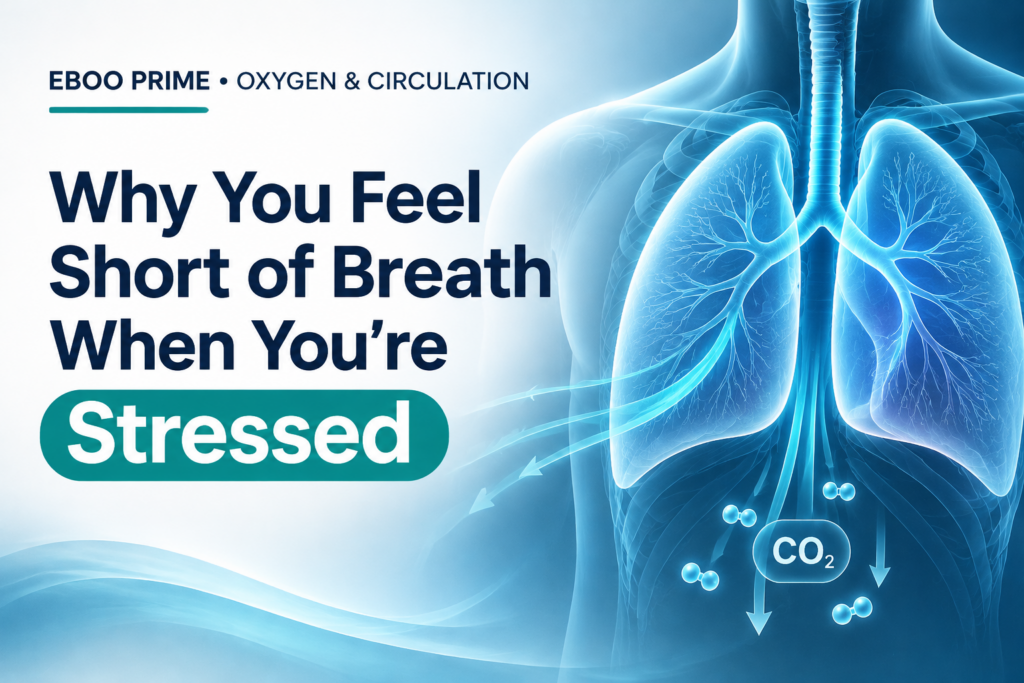
By Dr. Chris Cormier, DC — EBOO Prime We are an oxygen company, so people expect us to answer this question with oxygen. The honest answer is that it usually is not oxygen at all, and knowing that changes what actually helps. First, the part that is not negotiable Before anything else, because this matters more than the rest of the page put together. Breathlessness is a symptom that has many causes, and several of them are serious and treatable. New, sudden, severe or unexplained shortness of breath is a medical question, not a lifestyle one — and so is breathlessness that comes on at rest, wakes you at night, arrives with chest pain or pressure, or appears alongside swelling in your legs. Get those assessed promptly. Nothing below is a substitute for that, and no page on the internet can tell you which category you are in. This article is about a pattern that is diagnosed by a clinician after other causes have been considered — not a conclusion to reach at home. Now the counter-intuitive bit When somebody is anxious, stressed or in a difficult moment, breathing speeds up and often deepens. The sensation that follows is usually described as not getting enough air. What clinical references consistently report is that in this pattern, oxygen is not the problem. Hyperventilation has very little effect on arterial oxygen and almost none on oxygen saturation — and a pulse oximeter during one of these episodes typically reads at or close to 100%. You can feel as though you are suffocating while your blood oxygen is essentially perfect. Those two things are not in conflict — they are the same event seen from two sides. So what is actually changing? Carbon dioxide. Which most people think of only as waste, and which is in fact one of the most tightly regulated things in your body. Breathing faster or deeper than your body currently needs blows off more carbon dioxide than you are producing. Arterial CO2 falls, blood pH rises, and that shift — respiratory alkalosis — produces a specific and well-described set of sensations. Read that list again with fresh eyes. Every one of those is frightening, and fear drives breathing. Which is how the loop starts. The loop, and why it is self-sustaining It runs in one direction and it is remarkably tidy. Stress or anxiety speeds the breathing. Faster breathing lowers CO2. Low CO2 produces dizziness, tingling, chest tightness and breathlessness. Those symptoms are alarming, so anxiety rises. And rising anxiety speeds the breathing further. Nothing has gone wrong with your lungs or your heart in that sequence. A completely normal system is doing exactly what it is designed to do, slightly too enthusiastically, and the feedback is pointing the wrong way. Why “take a deep breath” is incomplete advice It is the most common thing anybody says in this situation, and it is aimed at the wrong variable. A big dramatic inhale moves more air, which is the thing already in surplus. What the pattern needs is less ventilation, not more — slower, smaller, and with the emphasis on the way out rather than the way in. That is why the breathing advice that works in these moments tends to look almost disappointingly gentle: through the nose, lower into the ribs rather than up into the shoulders, slower than feels natural, and with the exhale longer than the inhale. The long exhale is doing two jobs at once — it reduces how much you are ventilating, and it recruits the calming side of the nervous system. The fuller protocol is at BodyCharger, and the version written for a high-pressure moment is in how to stay calm during a procedure. And one thing to leave in the past The paper bag. Everybody has seen it in a film and a lot of people still believe in it. Current guidance has moved away from rebreathing into a bag, for a straightforward reason: it is only safe if you are certain the problem is not low oxygen — and nobody in the middle of an episode can be certain of that. If the underlying cause turns out to be a lung or heart problem, restricting fresh air is precisely the wrong move. The slow-breathing approach above achieves the same goal without that risk. The stress load underneath it If this pattern shows up often, the breathing is the visible end of something broader. Stress arrives in three forms — emotional, physical and environmental — and your nervous system does not file them separately, it adds them up. That is written up properly at The Nerve Health Institute, with the environmental half, which is the easiest to change, at BodyCharger. Sleep is worth singling out, because short sleep raises the whole system’s baseline and makes this pattern considerably more likely — oxygen and sleep covers that side. Where we sit, honestly We work in oxygen and circulation, and this is a page explaining that a common oxygen-shaped problem is not an oxygen problem. We do not treat anxiety, and we would not offer an oxygen intervention for the pattern described here — adding oxygen to a system whose oxygen is already at 100% does nothing useful, and the reasoning behind why more is not automatically better is at can you have too much oxygen. What we do, why oxygen delivery matters in general, and the wider landscape of approaches are in what EBOO is, why oxygen matters for the body and types of oxygen therapy. If your interest is the everyday fog-and-concentration question rather than breathlessness, that is why can’t I focus. When to stop reading and make an appointment Worth repeating in its own section, because it is the most useful paragraph here. The breathing pattern described on this page is something a clinician identifies after considering the alternatives. Being told that is what it is, by somebody who checked, is far more reassuring than deciding it at home —
Does Oxygen Improve Athletic Performance?

By Dr. Chris Cormier, DC — EBOO Prime Everybody has seen a player on the sideline with a mask on. And most people assume the answer here is a straightforward yes. It is more interesting than that. The evidence splits cleanly in two, and the dividing line is when you are breathing it — during the effort, or after it. One of those is well supported. The other is not. During the effort: the evidence is good found clear performance improvements while breathing oxygen-enriched air during the work itself. Time to exhaustion showed a large effect (g = 0.89). Time trials showed a small-to-moderate effect (g = 0.56), graded exercise tests a small-to-moderate effect (g = 0.40), and dynamic muscle function a small effect (g = 0.28). An inspired oxygen fraction of just 0.30 was enough for at least a small benefit — the effect does not require extreme concentrations. That is a real finding and it is the basis of training approaches that raise inspired oxygen during a session. The clinic version is written up at The Nerve Health Institute. After the effort: the evidence is not there Now the sideline mask, which is the more famous image and the weaker case. The conclusion is blunt: supplemental oxygen is not treated as a performance-enhancing substance because it does not work that way. The studies described include a JAMA trial in which twelve soccer players were given either 100% oxygen or a placebo gas after exertion — oxygen had no effect on plasma lactate and no effect on performance in a second bout, and the players could not tell which gas they had been given. A further study of thirteen athletes found no support for supplemental oxygen in events involving short intervals of submaximal or maximal exertion. And work in the European Journal of Applied Physiology found that oxygen during recovery between intervals did speed up how quickly saturation returned — but did not improve markers of oxidative stress or inflammation, because the change in saturation was too small to be clinically meaningful. A standard exercise physiology text puts it as a placebo effect with no real physiological benefit. Why the same gas does two different things The mechanism explains the split neatly, and once you see it the whole subject stops being confusing. Haemoglobin is already nearly full. The only thing extra oxygen adds is the small amount dissolved in plasma — and that only counts while you are breathing it. In a healthy athlete, blood oxygen content on room air runs at roughly 20.4 mL per 100 mL of blood. Breathing pure oxygen raises it to about 21.3. That is a real increase and a small one, and it disappears within moments of taking the mask off. So: during effort, when demand is high and every bit of delivery is being used, that small extra margin shows up as measurable performance. Afterwards, sitting on a bench with demand collapsed and saturation already returning on its own, there is nothing for it to do. Same gas, same physiology, completely different usefulness — because the timing is different. The underlying reasoning is in why oxygen matters for the body. And the part still being worked out Between those two sits the question of training adaptation: does using hyperoxia across a programme produce better results over weeks? The meta-analysis found a favourable trend, but the authors state directly that “small sample size and wide disparity in experimental protocols preclude definitive conclusions.” So the honest position is that working harder in the session is established, and whether that compounds into better adaptation is not yet settled. We would rather tell you that than imply otherwise. What this means if you are an athlete Four practical conclusions. A note on dose, since we are talking about volume More is not automatically better here either. Oxygen is dosed — pressure multiplied by time — and the reasoning behind short, timed sessions is set out at can you have too much oxygen. For anyone considering oxygen work alongside heavy training, the exertion deserves more scrutiny than the gas. Cardiac screening before intensive exercise matters far more than the oxygen question ever will. Where we sit in this EBOO is a circulation and oxygenation procedure, not a performance intervention, and we do not market it to athletes on the basis of the findings above. What it is and how it works are in what EBOO is, with the full landscape of approaches in types of oxygen therapy. If your interest is cognitive rather than physical, the everyday version of that question is at why can’t I focus. And as always, whether any of this suits you is a decision made with a clinician who has assessed you. Frequently asked questions Does oxygen improve athletic performance? During the effort itself, yes — a meta-analysis of 51 studies found clear improvements, with a large effect on time to exhaustion. Breathed afterwards on the sideline, the published evidence does not support a benefit to recovery or to subsequent performance. Does the sideline oxygen mask actually work? The published work says no. In a JAMA trial, twelve soccer players given 100% oxygen or placebo after exertion showed no difference in plasma lactate or in a second bout, and could not tell which gas they had received. A standard physiology text describes it as a placebo effect with no real physiological benefit. Why does oxygen help during exercise but not after? Because haemoglobin is already nearly saturated, so extra oxygen only adds a small amount dissolved in plasma — roughly 20.4 to 21.3 mL per 100 mL of blood. During high demand that small margin is used and shows up as performance. Afterwards, with demand collapsed and saturation recovering anyway, there is nothing for it to do. Does training with extra oxygen make you fitter over time? Not established. The meta-analysis found a favourable trend for hyperoxic training, but the authors state that small sample sizes and varied protocols
Can You Have Too Much Oxygen?

By Dr. Chris Cormier, DC — EBOO Prime Yes. And an oxygen company that cannot give you a clear answer to that question is not one to buy from. So here is ours, with the numbers, because the numbers turn out to be the reassuring part. Oxygen toxicity is real, well characterised, and uncommon — and the reason it is uncommon is that the people who work with oxygen take it seriously. The principle: oxygen is a dose This is the idea the whole subject turns on, and it is the one most marketing skips. Oxygen is a dose, not a quantity. The dose is pressure multiplied by time — and both halves matter. Not when you breathe a lot of ordinary air — when the pressure of the oxygen itself is raised, and for long enough. Which is why a hyperbaric session is timed, and why nobody is left in a chamber indefinitely. Room air is not the issue Worth saying plainly before anything else, because this page is not a reason to worry about breathing. Ordinary air is about 21% oxygen at normal pressure, which sits well below any of the thresholds involved here. You cannot overdose on fresh air, and breathing exercises do not carry this risk. The free end of oxygen work — movement, better breathing, ventilation, daylight — is written up at BodyChargers and carries none of what follows. The two kinds, and how common they actually are Central nervous system toxicity The acute form, seen mainly in hyperbaric settings at higher pressures. The published risk is— and the pressure dependence is the interesting part. At 2.8 to 3.0 atmospheres the risk rises to roughly 1 in 200. At 2 atmospheres or below it falls to about 1 in 10,000. Seizures, the outcome people worry about, occur in roughly 0.6% of oxygen toxicity cases. Early signs are specific and worth knowing if you are having treatment: twitching around the mouth or in the small muscles of the hand, ringing in the ears, nausea, disorientation or visual changes. High carbon dioxide, stress, fatigue and cold all make it more likely. If you notice any of those during a session, say so immediately rather than waiting to see. That is exactly what the staff are there for, and stopping is straightforward. Pulmonary toxicity The slower form, following prolonged exposure above 0.5 atmospheres, and accounting for roughly 5% of oxygen toxicity cases. It shows up as chest heaviness or pain, cough, shortness of breath and airway irritation. The reassuring detail is that most cases resolve within about four hours of stopping exposure. For scale: pure oxygen at sea level is tolerated for roughly 24 to 48 hours before severe tissue damage, while at 2 atmospheres moderate airway irritation begins after three to six hours — which is many times longer than any clinical session. How it is prevented, which is the part that matters Everything above is managed rather than merely accepted, and the measures are specific. Read that list again and notice what it adds up to: a well-run service is not one that gives you the most oxygen. It is one that gives you the right amount and stops. Who should say something first Several situations change the calculation and all of them belong on a form before anything is booked. More on that at what to tell a clinic before a procedure. And one thing this page is not If you have been prescribed oxygen — at home, overnight, or continuously — none of this is a reason to reduce it. Prescribed oxygen is dosed for you by somebody who assessed you, and the risks described here are the reason it was dosed rather than guessed. Never adjust prescribed oxygen on the basis of an article. If you have questions about your prescription, they belong with the clinician who wrote it, and they will be glad you asked. What this means when you are choosing somewhere Three questions, and they sort the field quickly. Ask what pressure and duration the protocol uses, and why. Ask whether air breaks are part of it. And ask what happens if you feel unwell partway through — the answer should be immediate, specific, and involve stopping. More in questions to ask before a procedure. What you are listening for is whether oxygen is being described as a treatment with a dose or as a commodity with a quantity. Unlimited access should prompt a question rather than excitement. Where this leaves the rest of the landscape Not every oxygen approach involves raised partial pressure, which is why the category matters — the overview is in types of oxygen therapy. EBOO is a circulation and oxygenation procedure rather than a pressurised one, and the constraint it addresses is delivery rather than dissolved concentration. What it is and how a session runs are in what EBOO is and what to expect in a session; the underlying reasoning is in why oxygen matters for the body. If a chamber is not suitable for you for any reason, the alternatives are set out at The Nerve Health Institute. As always, whether any of it is appropriate for you is a decision made with a clinician who has assessed you. Frequently asked questions Can you have too much oxygen? Yes. Oxygen toxicity occurs when oxygen is breathed at partial pressures above normal, for long enough. It is a dose — pressure multiplied by time — which is why hyperbaric sessions are time-limited and pressure-specified rather than open-ended. Can I get oxygen toxicity from breathing exercises or fresh air? No. Ordinary air is about 21% oxygen at normal pressure, well below the thresholds involved. Breathing work, movement and ventilation carry none of this risk. How common is oxygen toxicity during hyperbaric treatment? Uncommon, and strongly pressure-dependent. The published figure is around 1 in 2,000 to 3,000 treatments overall, rising to roughly 1 in 200 at 2.8–3.0 atmospheres and falling to about 1 in 10,000