What to Leave at Home on the Day of Your Procedure
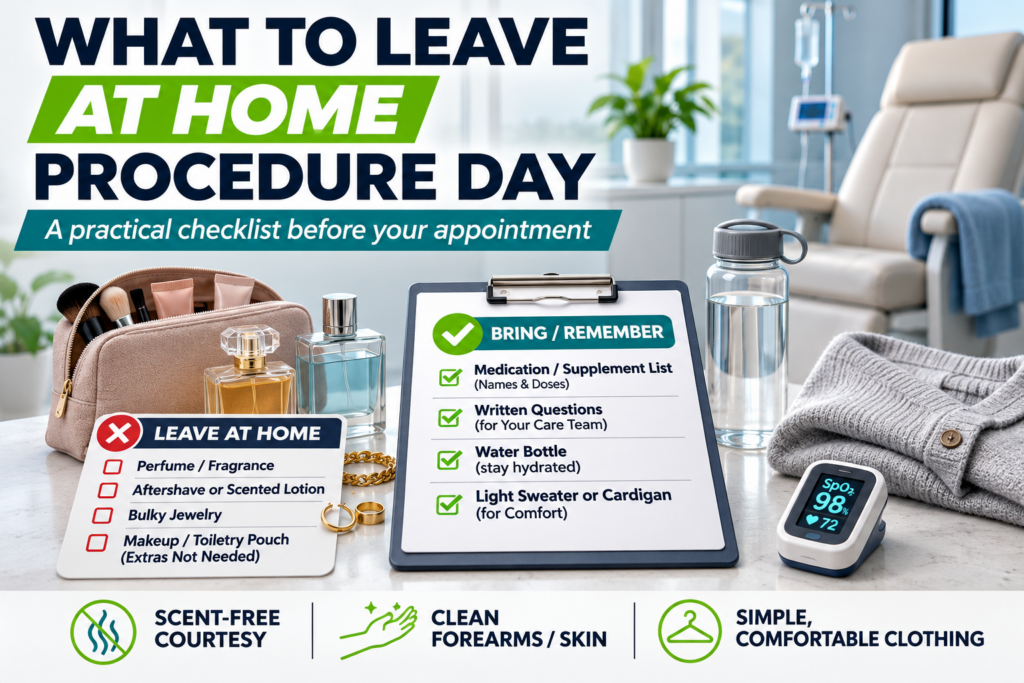
By Dr. Chris Cormier, DC — EBOO Prime Most advice on how to prepare for a procedure covers the conversation — what to ask, what to disclose. Very little of it covers the morning itself: what to put on, what to skip, and what to put in your bag. That is a gap worth closing, because when people ask how to prepare for a procedure the practical details are the ones they actually get wrong, and almost all of them take a minute to fix. This page completes a set of three. Questions to ask before a procedure is what to ask. What to tell your doctor before a procedure is what to say. This one is what to wear and what to bring. Perfume and aftershave, and the honest reason Most clinical settings would rather you came unscented, and we are going to give you the real reason rather than the usual one. We are not going to tell you your perfume is toxic. We do not know what is in it, you do not either, and as a claim it would be well beyond anything we could support. The reason is the person in the next chair. Fragranced products are a well-documented trigger of symptoms for a meaningful proportion of people, particularly those with asthma or other airway conditions, and those prone to migraine. In any clinical waiting room a disproportionate number of people are in exactly those groups, or are feeling nauseated, or are simply anxious and more sensitive to everything than they would normally be. Scent-free and scent-reduced policies are common across hospitals, schools and public buildings for that reason. We should be fair about the state of the evidence, because it is contested. Some clinicians argue that blanket scent bans are poorly supported and that the research base is thinner than the policies imply. That is a reasonable position and we are not going to pretend otherwise. But the case for coming unscented to a shared clinical room was never really an evidence argument. It is a courtesy argument, and that one is straightforward. And one reason that is purely for your own benefit Here is a consideration almost nobody raises, and it is the most interesting item on this page. Scent forms associations faster and more durably than any other sense, because it reaches the brain’s emotion and memory centres by a more direct route than sight or sound. Our colleagues at The Nerve Health Institute explain the anatomy in why smells trigger memories. Which has a practical consequence on procedure day. If you wear a scent you love to an appointment you are nervous about, you are pairing that scent with the nervousness. Most of the time nothing comes of it. Occasionally people find that a favourite fragrance has quietly acquired a clinical association they would rather it had not. So: if you want to wear something, wear something you are indifferent to. Save the one you love for a better occasion. Body Charger covers the deliberate use of this effect in how to use scent for sleep — the same mechanism, pointed somewhere more useful. Scented lotions and oils on your arms This one is purely practical. Whatever a procedure involves, if it involves access to an arm, that skin needs to be clean, dry and free of product. Heavy creams and oils interfere with skin preparation and with anything adhesive that needs to stay put. Nothing dramatic happens — you are simply asked to wash it off, which wastes a few minutes of your appointment for no reason. Wash as normal, skip the body lotion on your forearms, and that is the whole instruction. Nail polish: the advice that has actually changed For decades the standing instruction was to remove all nail polish before any procedure, on the grounds that it interferes with pulse oximetry — the fingertip clip that measures blood oxygen saturation. That advice is being revised, and we would rather tell you so than repeat an instruction out of habit. Experimental work presented at a European anaesthesia congress tested polishes of different colours and acrylic nails across varying physiological conditions and found none of them produced more than about one per cent variation in readings compared with untreated nails. The authors suggested hospitals should stop requiring removal. Older pilot work had found small colour-dependent differences, so it is not entirely settled. But the size of the effect looks much smaller than the instruction implied. What does affect those readings more is worth knowing, and it happens to be our subject: So our practical position: do not strip your nails on our account. Do tell us if your hands run cold, because that is genuinely useful information and it is a subject we have written about at length in why are my hands and feet cold. What to wear When people ask how to prepare for a procedure in terms of clothing, the answer is comfort, access and temperature, in that order. Jewellery, watches and the small stuff Leave valuables at home rather than in a bag in an unfamiliar room — it is one less thing to track on a day when your attention is elsewhere. Rings and watches on the arm being used should come off beforehand, which is easier at home than in a treatment chair. If a ring does not come off easily, say so when you arrive rather than struggling with it quietly. What to bring, rather than leave The other half of how to prepare for a procedure is the short list of things that genuinely help, and it is shorter than people expect. The night before The single most useful thing you can do the night before is sleep normally, and the single most common way people prevent that is by reading about the procedure at eleven at night. Do your reading earlier in the week, from your provider and from sources you have chosen deliberately, and then stop. Late-night searching