Why You Feel Tired After Eating
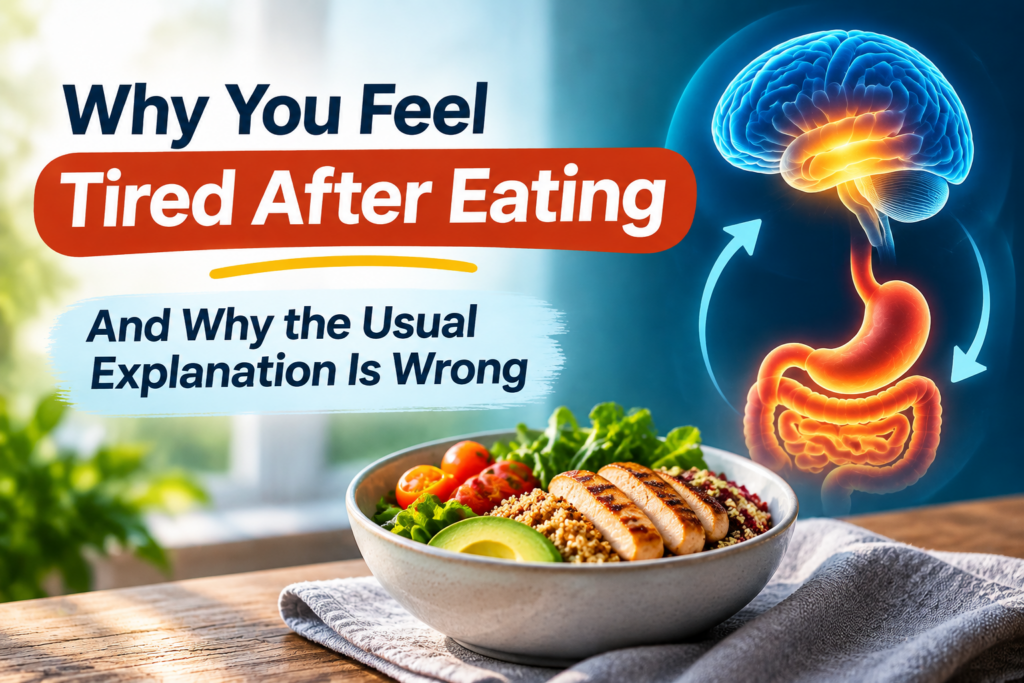
By Dr. Chris Cormier, DC — EBOO Prime Everybody knows the answer to this one. Your blood goes to your stomach to digest, so your brain gets less of it, and you get sleepy. It is tidy, it is intuitive, and it is the most widely believed circulation myth in everyday health. We work in circulation, so correcting it feels like our job. Why the blood-flow explanation does not hold The problem with it is a principle that sits near the centre of how the body manages blood supply. Cerebral perfusion is preferentially maintained. Your brain’s blood supply is defended across an enormous range of states — that is what autoregulation means. During hard exercise, when a very large share of your circulation is redirected to working muscle, flow to the brain is still held steady. The body does not leave the brain short. And when researchers have looked for the supposed post-meal drop, they have not found it. Measurements of flow in the common carotid artery show no meaningful change after eating. The brain is not being starved while you digest. There is a published paper on this question whose title begins with the word “Debunking”, which tells you how settled it is. Blood flow to your gut really does rise after a meal. It simply does not come out of your head. Where the extra blood actually comes from This is the genuinely interesting part, and it is a better story than the myth. Digestion is resource-intensive, and gut blood flow does increase substantially. The body covers that in two ways: by diverting flow primarily from skeletal muscle — tissue that is not doing much while you sit at a table — and by increasing cardiac output, pumping more blood per minute overall. In other words it does not rob one organ to pay another. It reallocates from somewhere idle and raises the total. The wider version of how delivery works is in why oxygen matters for the body. So what is actually making you sleepy? Several things at once, and the honest summary is that the exact mechanism is still being worked out. The leading explanations are chemical and neural rather than circulatory. The vagus nerve and the parasympathetic shift Food arriving in the stomach stretches it, and that stretch signals along the vagus nerve. Eating deliberately moves you onto the rest-and-digest side of the nervous system — which is precisely the side associated with being calm, still and unhurried. A general drop in energy is not a malfunction. It is the state digestion happens in. A large meal eaten quickly distends the stomach more, which signals more strongly. That alone explains a good deal of the difference between a sandwich and a Sunday lunch. Gut-brain hormones Eating triggers the release of a set of gut hormones and neuropeptides that act on the brain, including on the hypothalamus — which happens to be where arousal and sleep centres live. The current thinking is that these signals, along with vagal input, modulate those centres directly. Glucose and the alertness neurons The modest rise in blood glucose after a meal appears to be sensed by neurons in the lateral hypothalamus that produce orexin, one of the chemicals that keeps you awake. Those neurons are inhibited by glucose. Which is a neat and slightly comic arrangement: eating quietly turns down the wakefulness signal. What you ate, and how much Large meals do it more than small ones. High-fat meals are consistently associated with stronger post-meal fatigue, and large carbohydrate-heavy meals amplify it further. And while we are here: the turkey story is not true either. Turkey’s tryptophan content is comparable to chicken and beef and does not raise blood tryptophan more than other common foods. The Thanksgiving nap is the size of the meal, not the bird. What actually helps All of it unglamorous, and all of it free. If the issue is concentration more broadly rather than specifically after meals, that is a different question and it is covered in why can’t I focus. The part that connects to something larger There is a reason this page sits on a circulation and oxygenation site beyond simply correcting a myth about circulation. Digestion is a parasympathetic activity, governed through the vagus nerve. That is the same pathway that makes stress and digestion inseparable — if the alert side of your nervous system is running continuously, the side that handles digestion is getting less of the stage. It is not a metaphor; it is one nerve doing two jobs that compete. That relationship is central enough that irritable bowel syndrome is formally classified as a disorder of gut-brain interaction. The clinical write-up is at The Nerve Health Institute, and the practical day-to-day side at BodyCharger. The related case of stress changing your breathing is in short of breath when stressed. When post-meal tiredness is worth mentioning to a doctor Usually it is ordinary. Sometimes it is a signal, and it is an easy one to check. Raise it with your doctor if the sleepiness after meals is severe, happening most days, or getting worse — and particularly alongside heavy snoring or unrefreshing sleep, unusual thirst or urination, unexplained weight change, persistent fatigue regardless of eating, or feeling cold and run down generally. Those point toward things like sleep apnoea, blood sugar problems, thyroid conditions or anaemia — all common, all straightforward to test for, and all considerably better found than not. Where we sit EBOO is a circulation and oxygenation procedure. We would not offer it for post-meal tiredness and we are not suggesting you need anything for this — the honest answer to this question is smaller lunches, a short walk and enough sleep. What we do, and the landscape it sits in, is in what EBOO is and types of oxygen therapy. Why more is not automatically better in our field is in can you have too much oxygen. Frequently asked questions Why do I feel tired