Two Percent of You, Twenty Percent of Your Oxygen
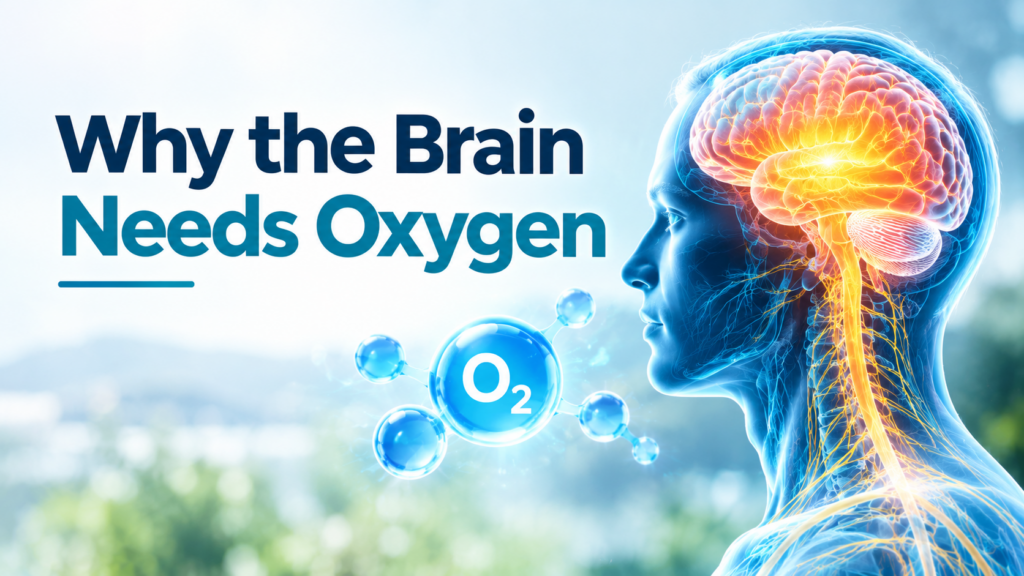
By Dr. Chris Cormier, DC — EBOO Prime If you want one number that explains why we talk about oxygen as much as we do, this is it. Your brain is roughly two percent of your body weight. It takes close to twenty percent of the oxygen your body uses at rest — around 49 millilitres a minute, every minute, awake or asleep, for your entire life. No organ in the body asks for more and none has less margin when it does not arrive. Oxygen is the first ingredient in every one of your roughly 30 trillion cells. The brain is simply the place where that is most obviously true. Why the demand is that high Because the brain never stops, and because of what it is doing while it does not stop. The National Institute of Neurological Disorders and Stroke describes it as “one of the hardest working organs in the body,” and sets out the scope plainly: “all sensations, movements, thoughts, memories, and feelings are the result of signals that pass through neurons.” Every item on that list is metabolic work. Maintaining the electrical charge across a nerve cell so it is ready to fire, firing it, resetting it, doing that constantly across a network wired to every muscle, bone, organ and gland you have — that is a continuous energy demand, and energy demand means oxygen demand. And a great deal of it is work you never notice. The autonomic side of the system is handling “blood pressure, heart rate, sweating, bowel and bladder emptying, and digestion” while you think about something else entirely. None of that is on your to-do list. All of it runs on the same supply. Oxygen is only half of it Here is the part people skip, and it is the part this whole brand is built around. Oxygen in your lungs is not oxygen in your cells. Between breathing it in and a cell actually using it, a lot has to go right — it has to cross into the blood, be carried, reach the small vessels, and get delivered into the tissue itself. So there are really two questions, not one: We went into the delivery side in detail in our piece on circulation and pelvic floor health, and the logic is identical wherever in the body you look. Supply and delivery are one system, and an honest conversation about oxygen has to include both. The eight hours nobody audits One practical note that belongs here, because it is the largest unexamined block of breathing in anyone’s life. Sleep is the longest continuous breathing session of your day — seven to nine hours, usually in a closed room, entirely on autopilot. If oxygen is something you care about, that is a lot of hours to never have thought about. We covered it properly in oxygen and sleep, and the first fix is free: open a window. What to do about it, starting today None of this costs anything, and it all acts on the first ingredient: The structured at-home version of all of this lives on BodyCharger, and it is where I would send anyone who wants a daily rhythm rather than a list. Where EBOO fits, stated plainly Given everything above, the obvious question is what a therapy focused on blood oxygenation has to do with the brain. We would rather answer that precisely than let anyone assume. What EBOO is Extracorporeal blood oxygenation and ozonation is a supportive wellness therapy focused on circulation and oxygenation. Blood is drawn, passed through a filter and an oxygenation and ozonation stage, and returned. The process is set out in full on our what is EBOO and how it works pages. People come to it as one element of a wider wellness picture — alongside training, nutrition, hydration, light exposure and sleep, rather than instead of any of them. What EBOO is not It is not a treatment for any brain or neurological condition. Not for stroke, not for dementia or cognitive decline, not for brain injury, not for any diagnosed neurological disorder. If you have neurological symptoms — changes in memory, speech, vision, balance, coordination, strength or sensation — those belong with a physician, promptly, and nothing on this page or any page substitutes for that assessment. Sudden changes of that kind are emergency-room territory, not wellness territory, and we would say so to anyone who asked us. So why write about the brain at all? Because the relationship between this subject and this therapy is a principle, not a claim — and the principle is worth more than a claim would be. Oxygen is foundational everywhere in the body, and the brain is the clearest illustration of it in existence: two percent of your mass, twenty percent of your oxygen, no reserve to speak of. Anyone who takes that seriously will take oxygen seriously everywhere else too — in how they breathe, in how they move, in the room they sleep in, and in how well what they breathe actually gets delivered. That is the thinking behind this brand, and it is the version of it we can stand behind indefinitely. Our FAQ page takes the same approach to every other question people ask us. The wider framework OWL: oxygen, water, light Oxygen, water and light, supported by frequency, magnetism and nutrients. Oxygen sits first for the reason this entire article is about — it is the ingredient with the least slack in it. Water sits second. Light is how the system keeps time. When it is nerve function rather than supply Supply is one question and signal is another. Where nerve function, chronic pain or autonomic balance are the live issue, that is clinical work — the 88-nerve assessment and in-person protocols at The Nerve Health Institute. More on how and why I practise this way is at drchriscormier.com. Frequently asked questions Why does the brain need so much oxygen? Because it never stops working and