Oxygen Therapy for Concussion Recovery: What Is Real and What Is Marketing
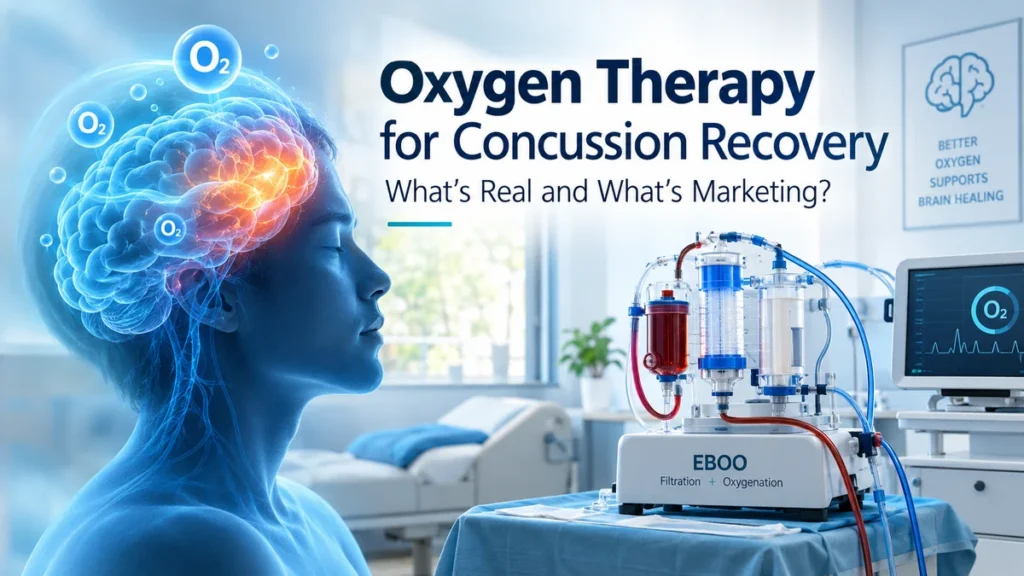
It is usually around the three-month mark that people start searching at night. The scan was clear, the two weeks came and went, and the headaches, fog and light sensitivity are still there. You have read the standard advice, you are doing it, and progress has stalled. So you widen the search — and oxygen therapy comes up almost immediately, described in terms that range from cautiously promising to frankly miraculous. This page is written to help you sort those claims out. What oxygen actually has to do with brain injury, where the evidence for oxygen therapy for concussion recovery genuinely stands, what EBOO is and is not, and what you should probably be doing before considering any of it. Why Oxygen Comes Up in Brain Injury at All The physiological reasoning is sound, which is part of why this area attracts so much overclaiming. A concussion sets off a cascade of metabolic changes. Injured neural tissue temporarily needs more energy than usual to restore normal chemical balance, and at the same time blood flow regulation is disrupted, so delivery of what that tissue needs is impaired. Researchers describe this mismatch as an energy crisis, and its timeline lines up reasonably well with the period when symptoms are worst. Follow that reasoning and improving oxygen delivery looks like an obvious intervention. It is a legitimate hypothesis. What it is not, yet, is a proven treatment — and the distance between those two things is where most of the marketing in this field lives. Where Hyperbaric Oxygen Actually Stands HBOT is the oxygen therapy most often promoted for concussion, so it is worth separating from EBOO before going further. Hyperbaric oxygen has approved medical uses, and it has been studied in traumatic brain injury for years. The results are genuinely mixed. Some trials report symptom improvement; others find that sham conditions produce comparable results, which raises questions about what is driving the effect. Reviewers have repeatedly concluded that the evidence base is not yet strong enough to establish it as a standard treatment for persistent concussion symptoms. The regulatory position follows from that. HBOT is not FDA-approved for traumatic brain injury or post-concussion syndrome, and the agency has previously warned about clinics promoting it for unapproved indications. You should know that before anyone takes your money, and any provider who does not raise it is selectively editing. That is not a reason to dismiss it outright. It is a reason to hold it as an option with uncertain returns rather than as the answer you have been looking for. What EBOO Is, and Where It Sits EBOO — extracorporeal blood oxygenation and ozonation — works on a different principle from hyperbaric therapy. Rather than raising ambient pressure, it circulates blood outside the body through a filtration stage and an oxygenation stage before returning it, in a continuous loop over roughly an hour. We are going to be direct about the evidence here, because you deserve it in writing: there is no meaningful body of research evaluating EBOO specifically for concussion or post-concussion symptoms. There is work on ozone therapy more broadly, mostly from Europe and mostly small. Applying that to brain injury is extrapolation, not evidence. Ozone therapy is also not FDA-approved for the treatment of any medical condition in the United States. What people report after sessions is improved energy and clarity. That is worth something, and it is also precisely the kind of outcome that individual reports are least able to establish. Both statements are true, and we would rather you weigh them yourself than have us pick the flattering one. What Actually Has Evidence Behind It If you are still symptomatic months after a concussion, this is the list that deserves your attention first, and it is not the expensive one. Graded aerobic exercise below symptom threshold. This is the best-supported intervention available for concussion recovery, and it is now recommended in international consensus guidance. Introduced early, it speeds recovery and substantially reduces the chance of symptoms persisting. It also benefits people whose symptoms are already long-standing. If you have been resting and avoiding exertion, this alone may change your trajectory. Cervicovestibular rehabilitation. Where dizziness, neck pain or headache have lasted beyond ten days, targeted work on the neck and balance systems is specifically recommended. The neck is involved in almost every mechanism that causes concussion and is frequently overlooked entirely. Sleep. Sleep disturbance after concussion is associated with slower recovery, which makes it a clinical priority rather than general advice. Vision and oculomotor work. Where reading, screens and busy environments are the problem, that points at eye movement coordination, which can be assessed and trained. Anyone offering you oxygen therapy before asking whether you have done these has the order wrong. Get them in place first. If you are still stuck afterwards, that is a more reasonable point to consider what else exists. Who EBOO Is Not Suitable For This matters regardless of what you decide about efficacy. EBOO is generally not appropriate where any of the following apply: There is a further point specific to head injury: a recent concussion is a reason to wait, not to book. Acute injury needs medical assessment and the standard recovery pathway first. Anything discussed here belongs to the persistent-symptom stage, not the acute one. A provider who does not screen for these, or who does not ask for recent bloodwork, is telling you something about their standards. What a Session Involves Screening comes first — history, current diagnoses, medications, recent labs, and where you are in your recovery. Sometimes the outcome of that conversation is that this is not the right time, or not the right option, and we will say so. The session itself uses access points in both arms and runs as a continuous circuit for roughly 45 to 90 minutes. You are awake and comfortable throughout. Afterwards, some people feel tired for the rest of the day and others feel noticeably clearer — neither reaction